
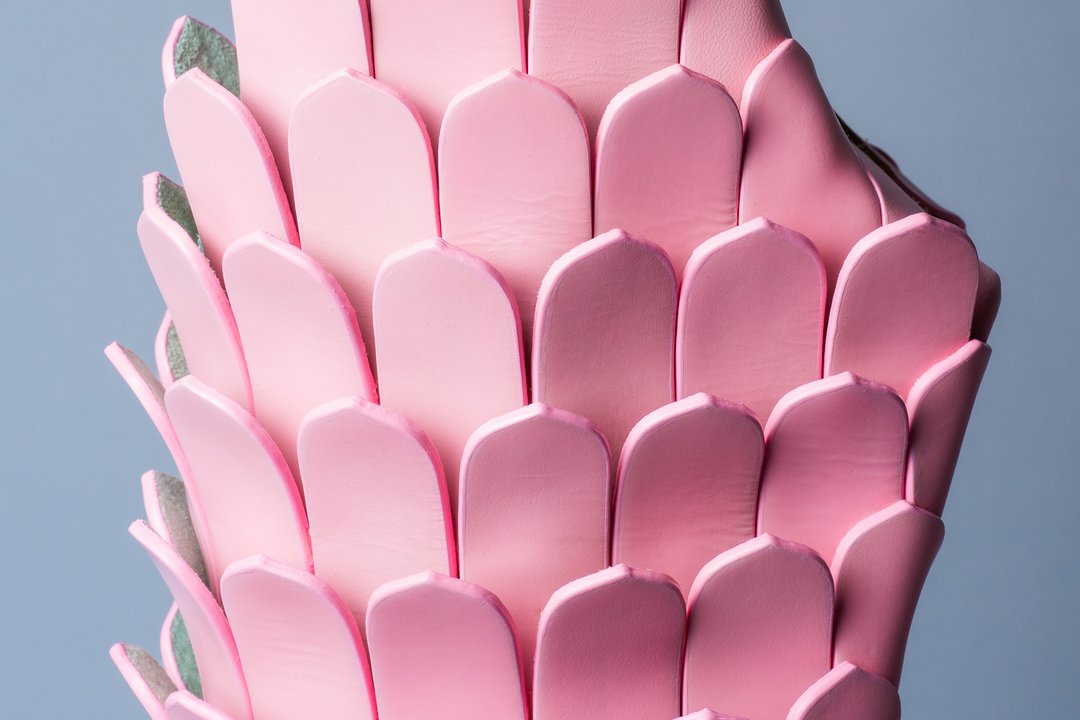
Noritaka Tatehana began his career with the Heel-less Shoes series, first shown on graduating from university, and the series marked its 15th anniversary in 2025. Since then he has taken the reconstruction of Japanese culture as his theme, working from a studio-based practice and expanding into painting and three-dimensional work, with Heel-less Shoes remaining the point of origin for all of it. This exhibition returns to that starting point.
The shoes did not come from a formal idea but from research into Japanese culture. Tatehana, who studied dyeing and weaving at Tokyo University of the Arts, came to see tradition not as mere preservation but as something that once appeared as innovation, and turned his attention to the costume culture of Edo-period oiran. Oiran set fashions of the day, and their styles spread through society as townswomen copied them; unlike expressions institutionalised as kabuki costume, this took shape organically within urban culture.
The work is not inspired by tradition but constructed by studying it. The tall geta worn by oiran were not simply footwear. Extreme height was permitted only to the highest-ranking tayu, and the height itself functioned as a sign of social standing, lifting the body vertically to embody hierarchy.