
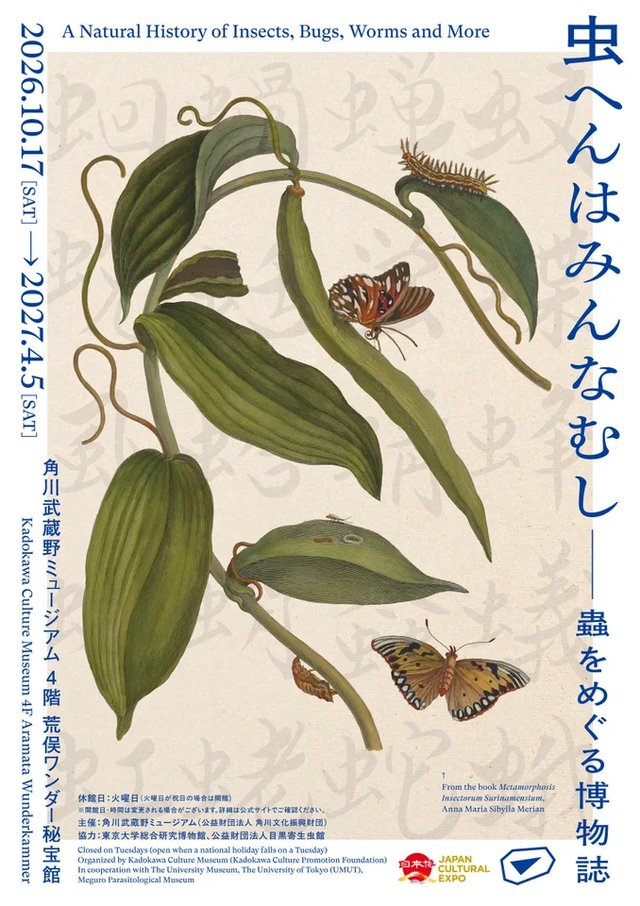
The exhibition is held on the 4th floor of the Kadokawa Culture Museum, in the Arima Wonder Hihokan gallery, and draws on the natural-history picture collection assembled by Hiroshi Aramata, who advises the museum's natural history section and compiled the monumental World Natural History Illustrated. Before photography and microphotography existed, painters and naturalists drew the plants and animals they observed, and researchers gathered specimens that became the basis of taxonomy. The show follows an earlier exhibition on the theme of birds with one devoted to insects.
The word for 'bug' in the illustrated books of the past covered far more than what biology now calls insects. Maria Sibylla Merian's Metamorphosis Insectorum Surinamensium includes lizards and spiders, and the Edo-period Senchūfu lists frogs and shrimp among creatures bearing the insect radical. The classical Chinese Book of Rites grouped animals into five classes, humanity among them.
Materials are shown with the cooperation of the University of Tokyo University Museum and the Meguro Parasitological Museum, including rare Edo-period books and parasite specimens. Collecting and classifying nature is presented as a record of how people have looked at, understood and used the natural world.