
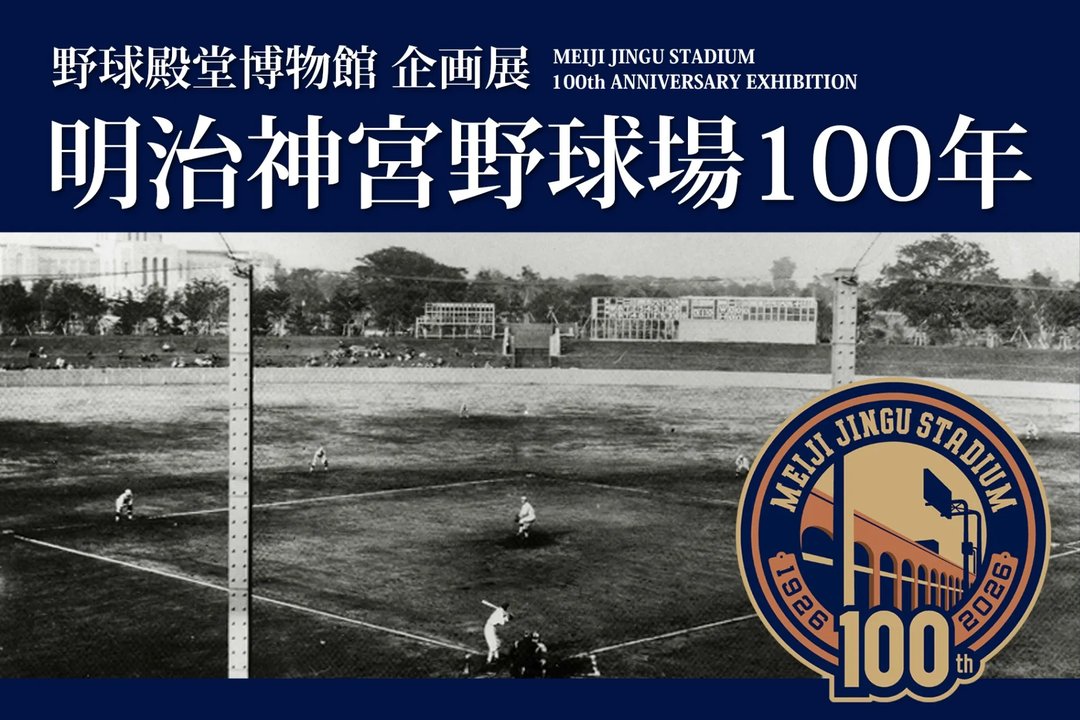
The exhibition marks the 100th year since Meiji Jingu Stadium was completed, and traces how the ground became a stage for much of Japanese baseball history. The stadium is home to the Tokyo Big6 Baseball League and the Tohto University Baseball League, and hosts the All Japan University Baseball Championship that decides the national university champion. It was also the setting for the 1934 Japan-US baseball tour that led to the birth of professional baseball in Japan, and for the first game of the first Japan Series in 1950.
From 1964 it became the home ground of the Kokutetsu Swallows, now the Tokyo Yakult Swallows. The display brings together materials connected to games and events at the stadium, along with equipment used by players who made their names there, presenting both the history and the present of the ground. Highlights include a poster from the first Japan World Series in 1950 between the Mainichi Orions and the Shochiku Robins; the winning ball from Masatake Yamanaka's record 48 wins in Tokyo Big6 play; the home run ball from Tadahito Iguchi's record 24th home run in the Tohto league; and the uniform worn by manager Takahiro Ikeyama for JINGU STADIUM DAY, held to mark the 100th anniversary of the founding of Meiji Jingu Gaien.
Further items scheduled for display include a section of the stadium's outer wall from the time it was built, an LED module from the current scoreboard screen, the Tokyo Big6 league's Emperor's Cup (for a limited period), the bat Yoshinobu Takahashi used for his record 23rd home run, the winning ball from Hiroaki Shibaike's record 41 wins, and uniforms worn by Masaichi Kaneda and by manager Katsuya Nomura.