
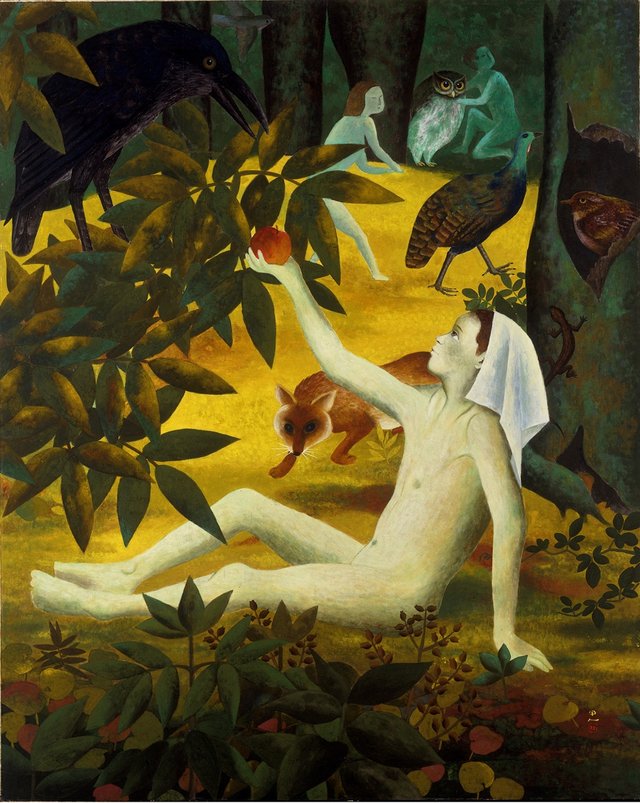
Kojin Kudo (1915-2011) was born in Hirosaki, Aomori Prefecture, and moved to Tokyo in 1935 to study Japanese painting at the Kawabata Painting School. He studied under Toyoshiro Fukuda and pursued a formally experimental kind of Japanese painting, an approach interrupted when he was drafted; the experiments begun before the war carried into his postwar work. In 1950 he was first accepted at the Sobi Art Exhibition, which aimed to reform Japanese painting, and went on to become a central figure in the Japan Art Department of the Shinseisaku Association and in the Soga-kai, drawing on the nature of his home region.
The exhibition marks the 110th anniversary of his birth and covers roughly 70 years of work through 86 pieces, including major works from his early years to his late period, small preparatory sketches and painting materials, together with 7 works by related artists, 93 in total. A prologue section introduces artists of the Shinbijutsujin Kyokai, with whom Kudo was active before the war. His own earliest prewar works have been lost, so photographs of them are shown alongside paintings by Toyoshiro Fukuda, Kenji Yoshioka, Fumiko Hori, Ato Sakai and others who worked in the same group, tracing the formal continuity from the prewar to the postwar years and bringing into view what Kudo was aiming for in his practice.
It is the first full-scale museum retrospective since one held in the artist's home prefecture of Aomori in 2007, 19 years ago, and the first in Kanagawa Prefecture since one at this museum in 1991, 35 years ago.