
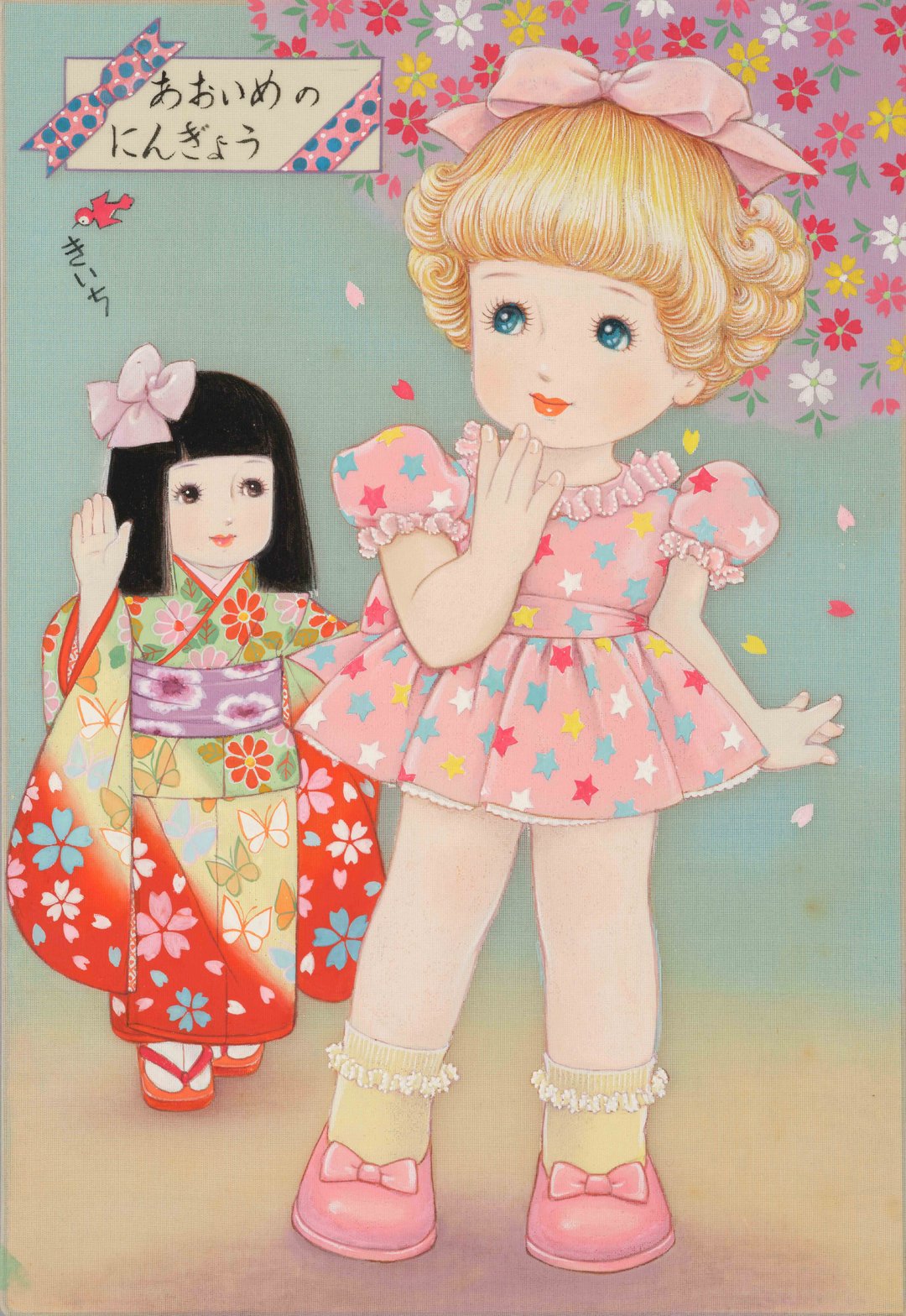
Kiichi Tsutaya (1914–2005) was born in Tokyo's Tsukiji district into a family of paper wholesalers. He studied Japanese painting at the Kawabata Painting School, drawn to artists such as Kasyo Takabatake and Shuho Yamakawa, and began making colouring-book pictures in 1940 under the pen name Fujio. After the war his "Kiichi no nurie" colouring sheets, sold as toys in penny-sweet shops rather than through publishers, became a nationwide craze in a country with little entertainment to offer.
The pictures faded as manga, anime and TV heroes arrived in the 1960s, then returned to attention in 1974 through Kiichi goods at the Culture-ya Zakka-ten, and again after a 1978 exhibition at Shiseido The Ginza. A 2002 exhibition curated by Takashi Murakami at the Fondation Cartier in Paris moved the work into an art-historical context. This exhibition presents 34 works from the "Dojo Hyakutai" series, which Tsutaya worked on energetically from around 1985 using Japanese-painting techniques on silk.
The round faces, oversized eyes, three-head-tall bodies and outlined figures are read as a prototype for Japanese manga characters and as an ancestor of today's kawaii culture. The paintings come from the collection of Daisuke Soda, who began visiting the artist's studio in 1983 and acquired finished works over many years; they have been kept privately and never shown publicly until now. A catalogue with an essay by Soda and a text by Takeshi Kudo, curator of the "Bijogirl" art history exhibition, is published by NANZUKA Publishing to accompany the show.