
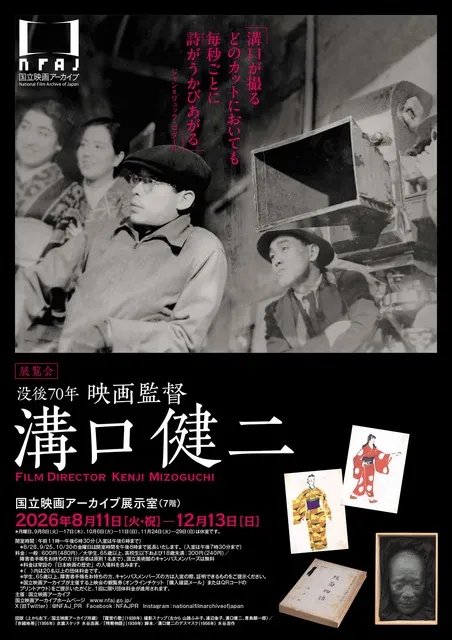
Kenji Mizoguchi (1898-1956) was born in Tokyo and set out to become a painter before joining the Nikkatsu Mukojima studio in 1920. He began directing in 1923 with "The Day of Resurrection of Love," and after the Great Kanto Earthquake moved his base to a Kyoto studio, where he continued to turn out a wide range of films. His 1936 films "Naniwa Elegy" and "Sisters of the Gion," which portray women sacrificed by society with unsparing realism, mark one peak of his career.
The 1939 period piece "The Story of the Last Chrysanthemums" and the 1941-42 "The Loyal 47 Ronin," mounted on an unprecedentedly huge set, showed that Mizoguchi had become a driving force in Japanese cinema. After the war came "Women of the Night" (1948), a comeback work, followed by a run of masterpieces drawn from classical Japanese literature: "The Life of Oharu" (1952), "Ugetsu" (1953) and "Sansho the Bailiff" (1954), which won prizes at the Venice International Film Festival three years in a row. His long takes, frequent camera movement and perfectionist direction brought Japanese cinema's high artistry to international attention and inspired filmmakers around the world, among them the French New Wave directors, Theo Angelopoulos and Andrei Tarkovsky.
The exhibition marks the 70th year since his death and is the first devoted to him. It covers his life's achievements, his methods of filmmaking and his contribution to world cinema, and draws on materials left by the celebrated "Mizoguchi-gumi" staff, including cinematographer Kazuo Miyagawa, art director Hiroshi Mizutani and composer Fumio Hayasaka, to analyse his direction.