
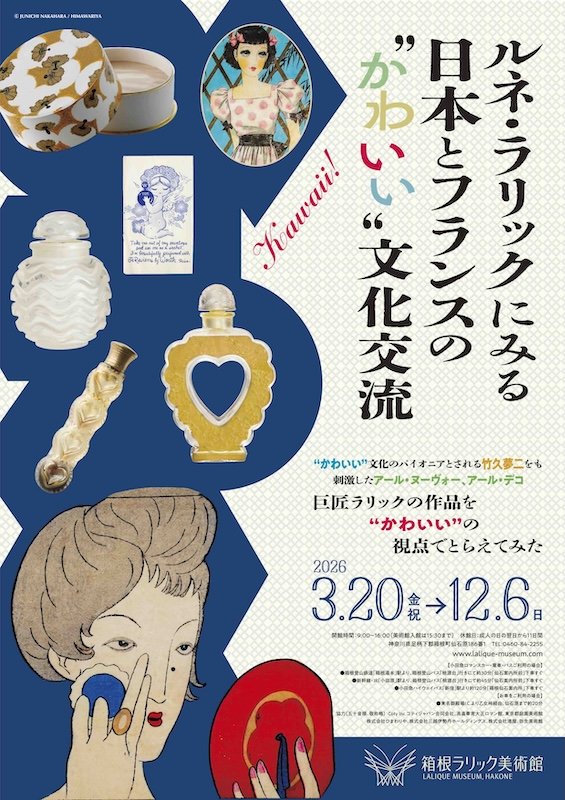
The exhibition sets Japan's kawaii culture beside the work of René Lalique (1860-1945), the French master of jewellery and glass. The two may look unrelated, but the history of kawaii runs back through Japonisme. Art Nouveau, which drew on Japanese taste, and the Art Deco that followed were both fashionable in Japan in their day, a kind of cultural reimport.
Takeo Takehisa (1884-1934), a pioneer of kawaii working at roughly the same time as Lalique, shows clear traces of both styles. His work in turn fed artists such as Junichi Nakahara (1913-1983), whose designs brightened the everyday lives of young women. Lalique's own work fascinated Japanese viewers of the period.
He wanted to bring beautiful things to more people, and moved from one-off jewellery to glass that could be made in quantity; that aim reached as far as Japan. Many of his pieces still read as cute by present-day eyes. The show reconsiders the museum's own collection through the idea of kawaii.