
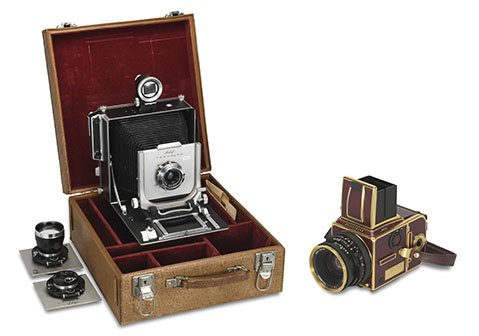
The exhibition draws on the collection of Sadayoshi Imai, a Hokkaido-based businessman who has spent more than 50 years gathering cameras from Japan and abroad, supplemented by items from the museum's own holdings. Linhof was founded in Germany by Valentin Linhof in 1887 and began making cameras in the early 1900s. The company's Technika, released in 1934, established its reputation as a multi-functional, high-precision metal-bodied technical camera.
Its lens board, the Linhof board, was adopted by other camera makers and became a de facto universal mount. Hasselblad began in Sweden in 1841 as a trading company founded by Victor Hasselblad. After moving into photographic materials, it developed an aerial camera in 1941 and released its first consumer camera, the 1600F, in 1948.
The body was designed by Sixten Sason, who also worked on Saab automobiles, and the brand's 6x6 single-lens reflex format became a standard that many other cameras followed. The show examines both professional brands through their history, functionality and design, and the qualities of medium- and large-format cameras and high-definition photography. It is aimed at camera enthusiasts as well as newcomers to serious photography and young people hoping to become photographers.