
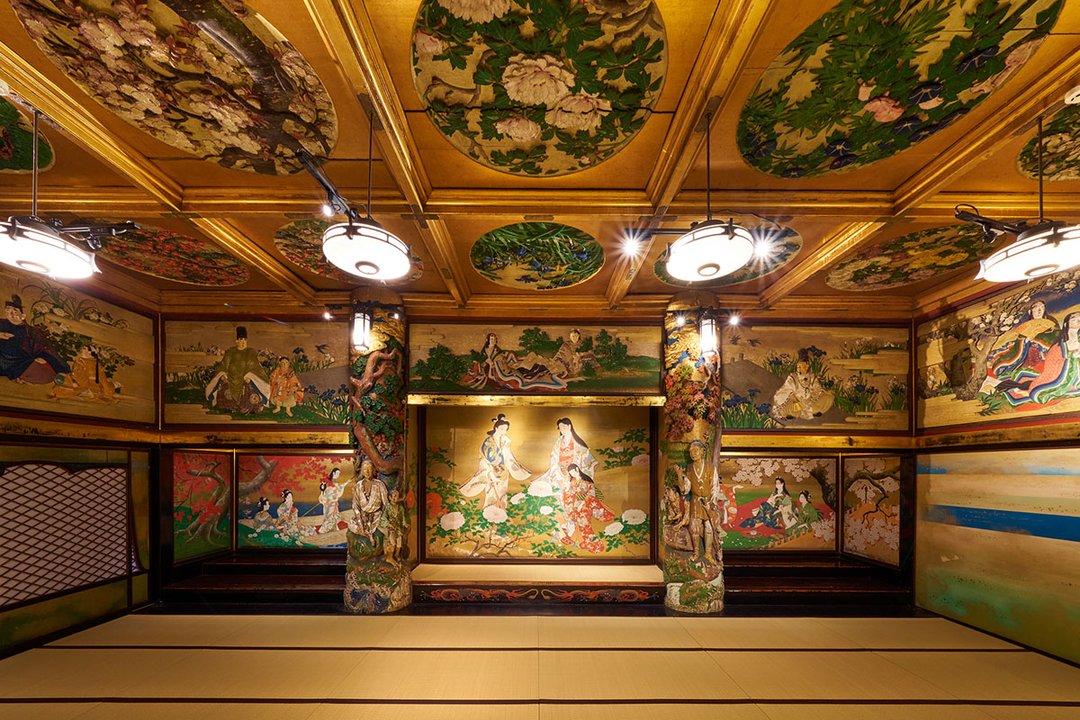
The Hyakudan Kaidan is a wooden building completed in 1935 and now designated a Tokyo Metropolitan Tangible Cultural Property. It once served as the banquet halls of a traditional Japanese restaurant, and a long corridor of 99 steps connects the seven rooms where celebrations were held. Each room reached along the staircase has its own design, and the building's defining quality is the extraordinary richness of its decoration.
The rooms hold 126 Japanese paintings by painters representative of the early Showa period, mother-of-pearl inlay work, kumiko lattice screens assembled without nails or glue, more than 750 cloisonné pieces set into the ceilings, and a roughly 200-year-old hinoki cypress floor post. This special opening, the first in about a year, displays almost no added exhibits, letting visitors see the cultural property building as it is, down to the smallest detail. A mother-of-pearl inlaid revolving table, said to be the oldest surviving example and restored from a prewar original, is shown in the Juu-se no Ma room along the Hyakudan Kaidan.
The room is known for its mother-of-pearl decoration, and this is the first time the two are shown together, for a limited period.