
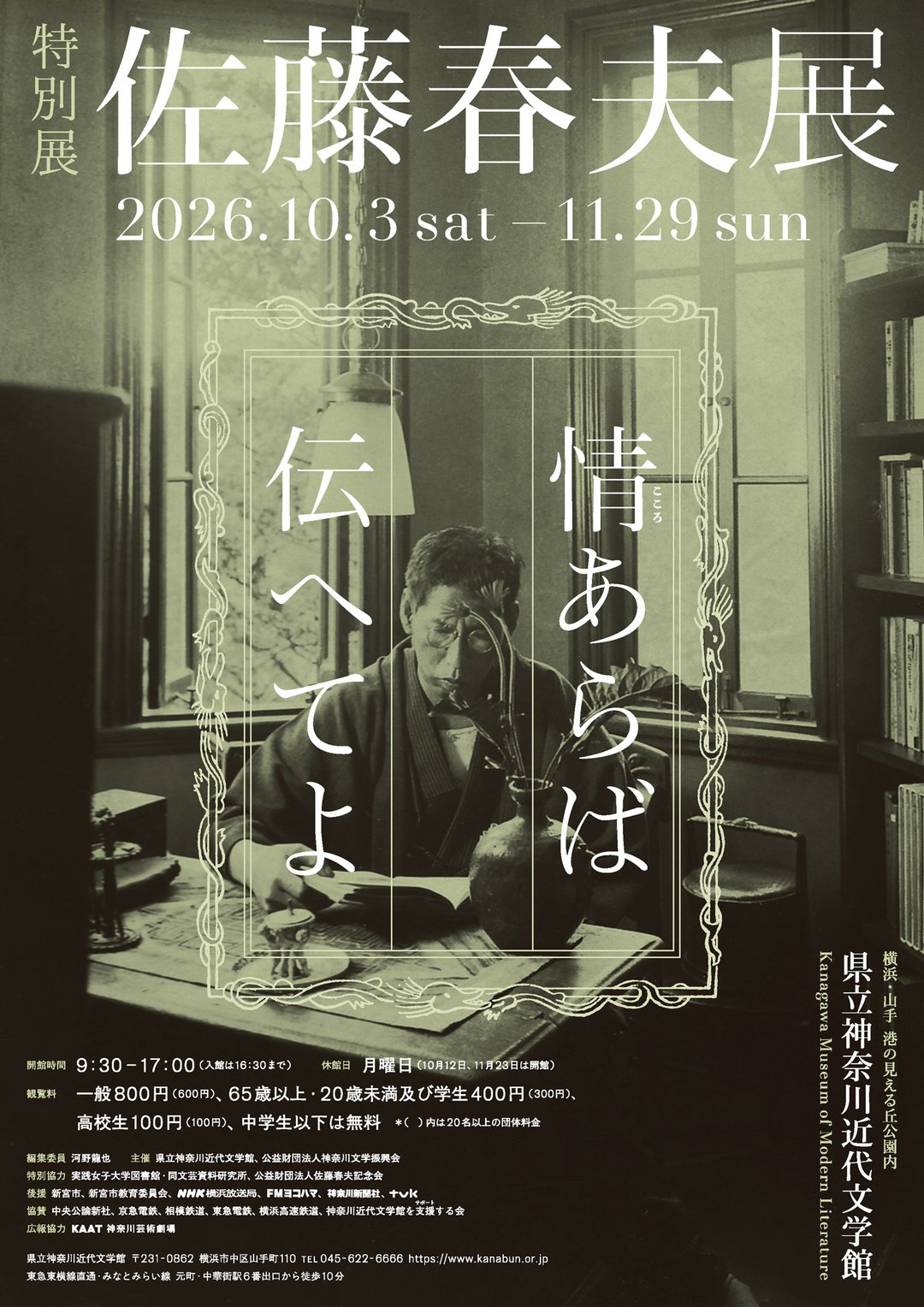
Haruo Sato (1892–1964) worked across poetry, fiction and the essay from the Meiji era into the Showa period. He is said to have counted some three thousand friends and disciples, and his influence on modern Japanese literature was considerable. At 24 he lived in Nakazato village in Tsuzuki district, Kanagawa (now part of Aoba ward, Yokohama), and the experience became the basis of his novel Denen no Yuutsu (Rural Melancholy), which established him as a writer.
His poem Sanma no Uta (The Saury Song), born of the so-called Odawara Incident, is known as one of the representative lyric poems of modern Japanese poetry. Kanagawa runs deep through his work. The exhibition follows the writing of a man known for his rebellious spirit.
It also presents letters from a wide circle of writers, among them Junichiro Tanizaki, Ryunosuke Akutagawa and Osamu Dazai, to approach the real figure of Haruo Sato the person, who captured so many readers. Three related talks are scheduled, all in the exhibition hall on the second floor of the museum. On October 11 at 14:00, Ryuya Kono, associate professor at the University of Tokyo and an editor of this exhibition, speaks on reading Sato.