
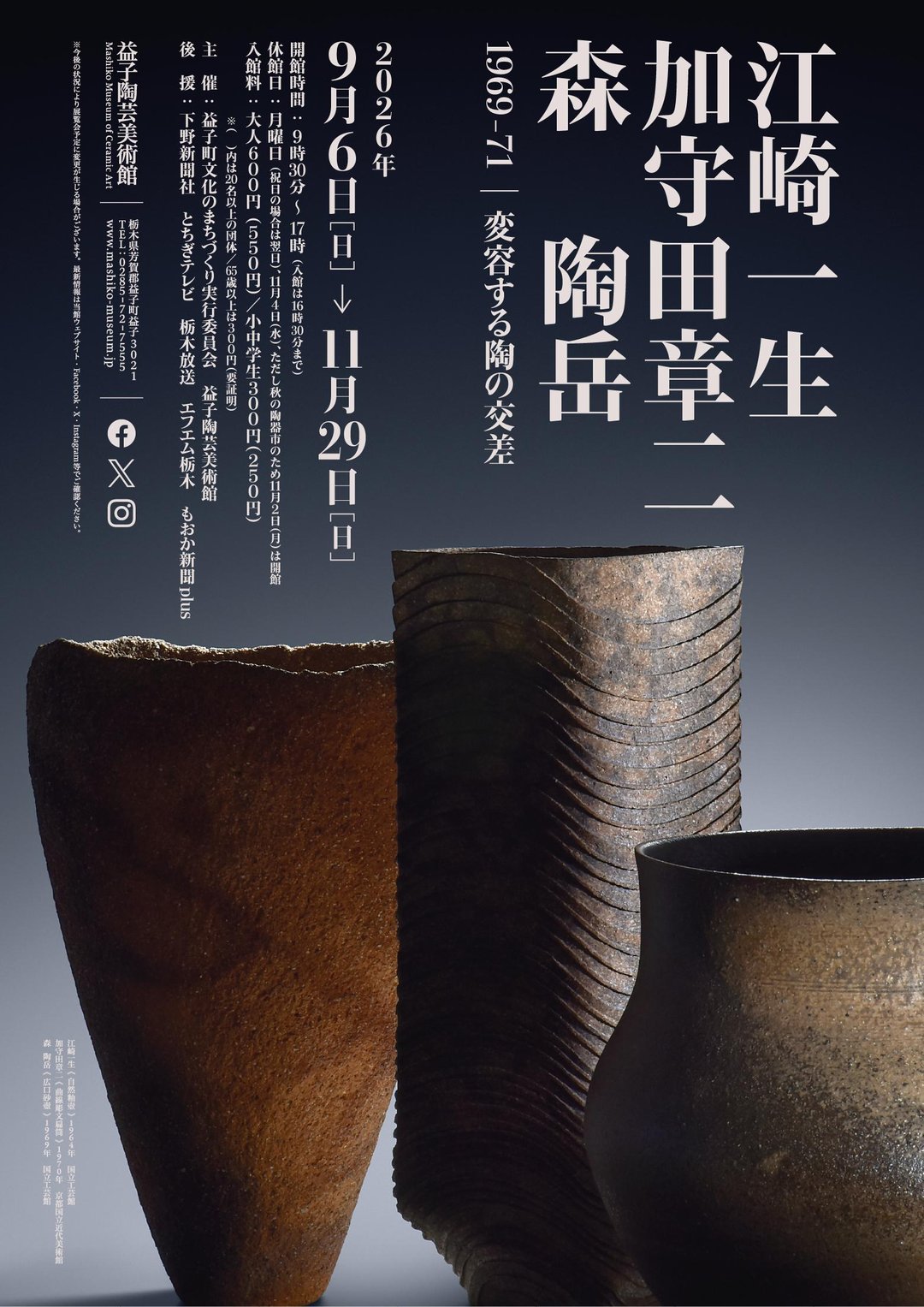
A three-person exhibition of Issei Ezaki, Shoji Kamoda and Togaku Mori was held at the Kotsu Kaikan Gallery Te in Yurakucho, Tokyo, in each of the three years from 1969 to 1971. It was organised by Kozo Yoshida, then a curator at the National Museum of Modern Art, Tokyo, who selected the artists he considered the most active of the day. Yoshida set out an unprecedented kind of creative ceramics as the theme, and the three artists followed it closely, producing works still discussed today.
Issei Ezaki (1918-1992) was a potter from Tokoname known for ash-glazed pieces modelled on old Tokoname ware. He began as a wheel-throwing craftsman making large objects such as braziers, turned to pottery in 1956, and on Toyo Kaneshige's advice devoted himself to the study of old Tokoname. Shoji Kamoda (1933-1983) worked in Mashiko, making ash-glazed and sculptural unglazed stoneware.
For the first of the three exhibitions he showed stoneware, for the second curved-line carved decoration, and for the third coloured pottery, one masterpiece after another in ceramic history. Togaku Mori (born 1937) is a Bizen potter who studied old Bizen and is known for reconstructing the large kilns used in Bizen in the Momoyama period. In this exhibition he presented new earthenware-like works entirely different from his earlier style.