
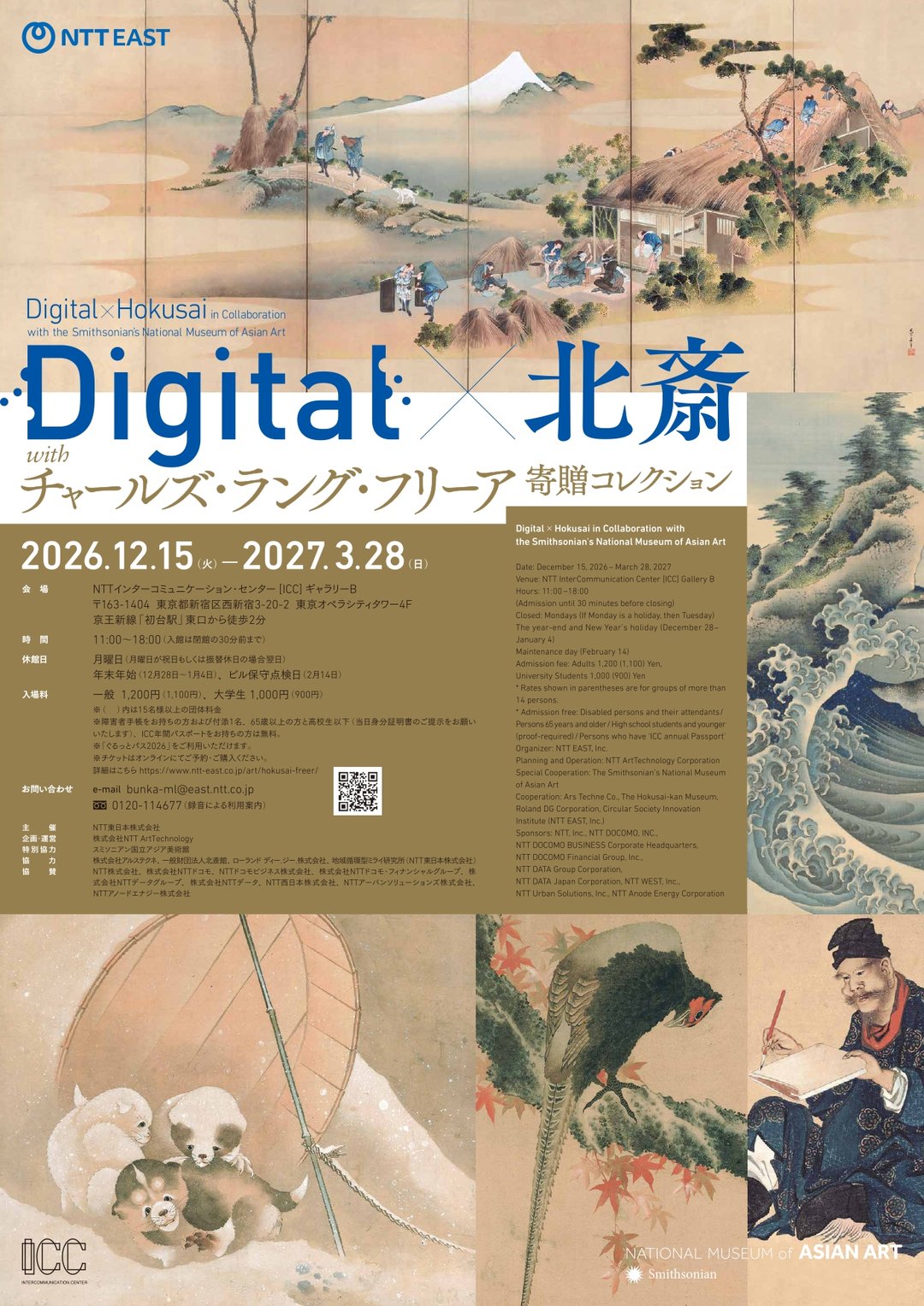
This edition of the Digital × Hokusai series focuses on Hokusai works held by museums outside Japan. Charles Lang Freer (1854–1919), who made his fortune in the American railway business, deepened his interest in Asian art through his friendship with the painter James McNeill Whistler. Pursuing a universal beauty shared by East and West, he assembled a collection of Asian art, Japanese art among it, chosen with a discerning eye.
His holdings of Hokusai's paintings are said to be the finest in the world. After Freer's death in 1919 the collection was donated to the Smithsonian Institution, and in 1923 the National Museum of Asian Art opened as the first national art museum and Asian art museum in the United States. Freer's will, however, restricted display of the works to the museum building, so chances to see them have never been plentiful.
As part of the celebrations of the 250th anniversary of the founding of the United States, and with the cooperation of the Smithsonian's National Museum of Asian Art, a selection from Freer's collection is presented here. The Hokusai works the museum chose are folding screens. Very few Hokusai screens remain in Japan, and every work shown is a rare one.