
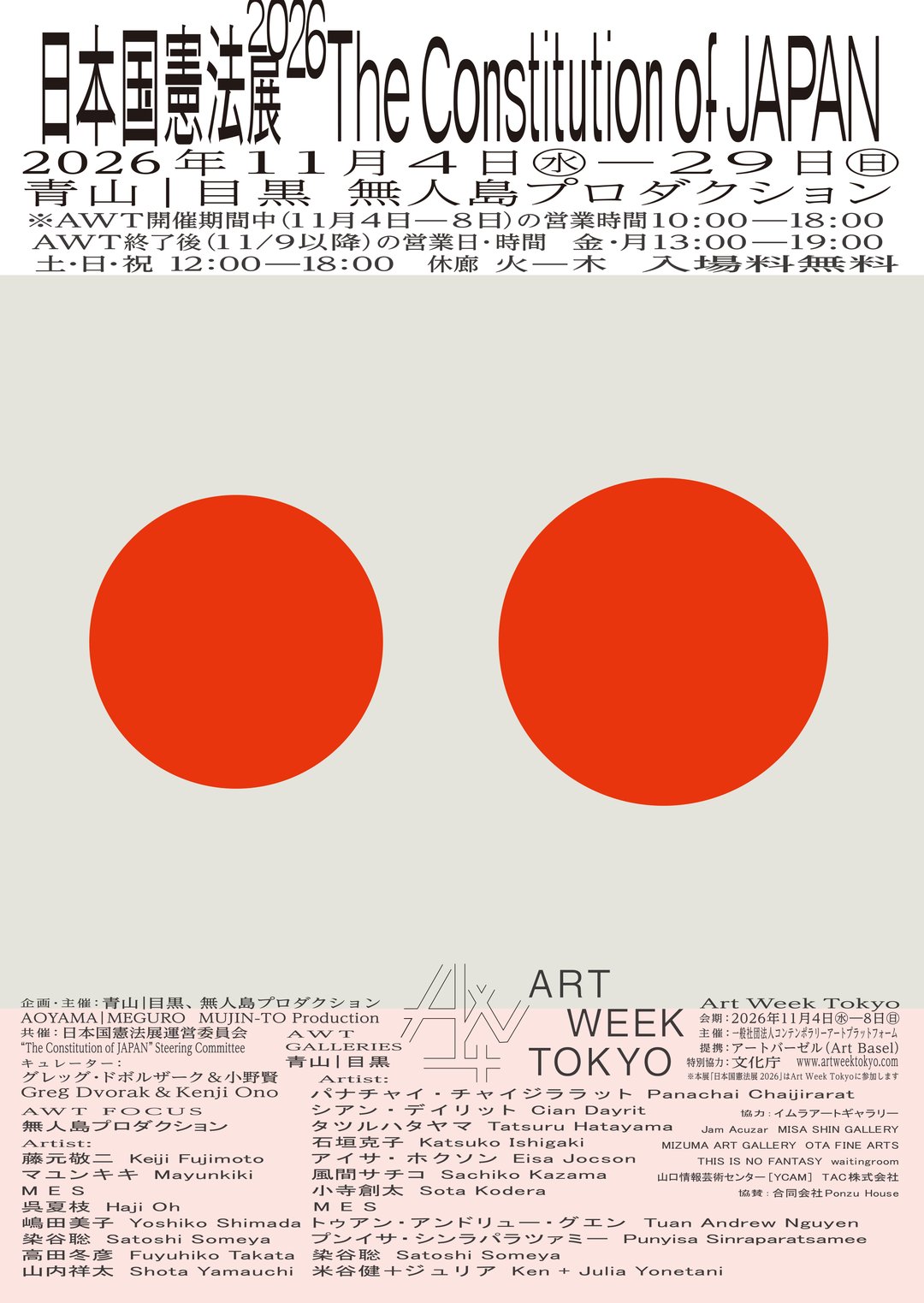
The fourth instalment in a series of exhibitions marking the constitution of Japan, which came into force in 1947 after being drafted between wartime compromise and the wish to rebuild the state anew. Roughly eighty years on, at a moment of deepening uncertainty, the constitution sits at the centre of political debate. The show unfolds across two Tokyo galleries, each taking a contrasting postwar history of a surrounding area as its starting point, and asks about the gap between the constitution's ideals and the uneven world people actually live in.
At Mujin-to Production in eastern Tokyo the theme is the shelter: the resilience of people who hold on under unstable conditions, survive, and carve out a place to live while resisting exclusion and erasure. At Aoyama|Meguro in western Tokyo the theme is the sweatshop: how power disciplines bodies, exploits labour and drives the consumption of land, normalising hidden violence as stability and comfort. Moving between the two venues is presented as a way to read the constitution more broadly, not only through what it has failed to protect but through the people who push back its limits in pursuit of freedom and rights.