
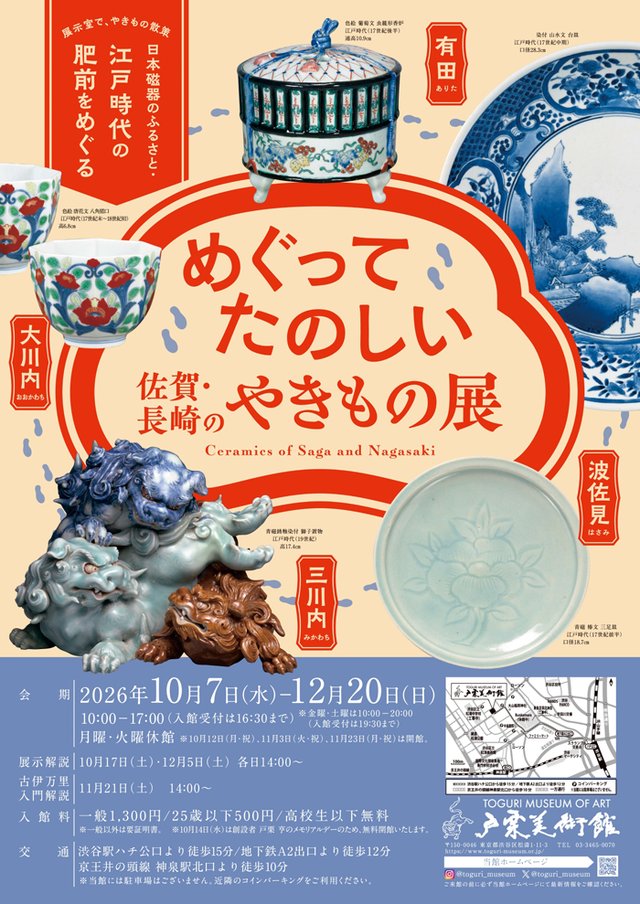
Pottery production began in what is now Karatsu, Saga Prefecture, at the end of the 16th century and spread through the region. Japan's first domestically made porcelain appeared in the early 17th century, and porcelain firing advanced rapidly around Arita. Kilns also rose and fell in Okawachi within present-day Imari to the north of Arita, in Itanokawachi in Takeo to the east, in Shida in Ureshino, in Hasami in Nagasaki Prefecture to the south, and in Mikawachi in Sasebo to the southwest.
More than 300 climbing kilns are said to have operated within this roughly 30 km radius alone. Though the areas are close together, each produced wares with its own character. The exhibition divides two galleries by geography: one for Arita, and one for Okawachi, Itanokawachi, Shida, Hasami and Mikawachi.
About 80 pieces are shown, mainly Edo-period porcelain from the kilns that are still working today. Visitors are invited to stroll through the rooms.