
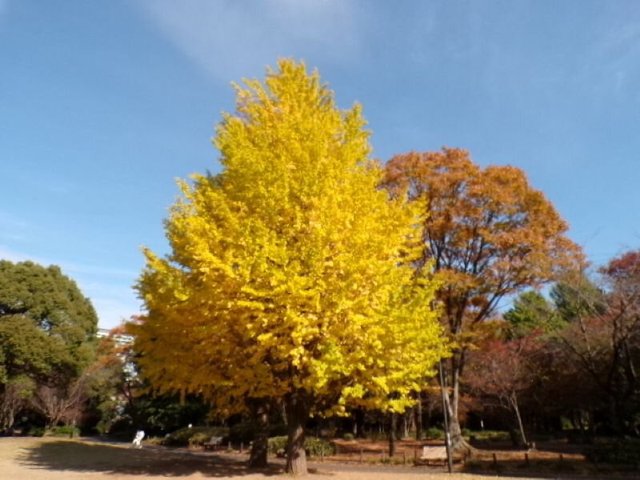
Kitanomaru Park occupies the former northern enclosure of Edo Castle and forms part of the Imperial Palace Outer Gardens, a national park where a wooded, satoyama-like landscape survives in the middle of the city. It opened in 1969 to mark the 60th birthday of Emperor Showa, and many deciduous trees were planted across the grounds, among them Japanese maples, zelkova, konara and sawtooth oak. Colour usually begins in mid-November, with the best viewing from late November into early December.
On the maple hill to the west, red leaves cover the slope and a small waterfall runs close by. The pond on the lawn area reflects the surrounding trees, so the water itself turns autumnal. Many of the ginkgo trees are tall enough that their yellow leaves read clearly from a distance.
The large ginkgo in front of Nippon Budokan has a thick trunk and peaks in early December. Because the park holds a wide range of species, including star-leaved sweetgum, katsura with its sweet scent and the maple-leaved mukuroji, reds and yellows overlap over a long stretch of the season. Trees bearing fruit that birds favour are also plentiful.