
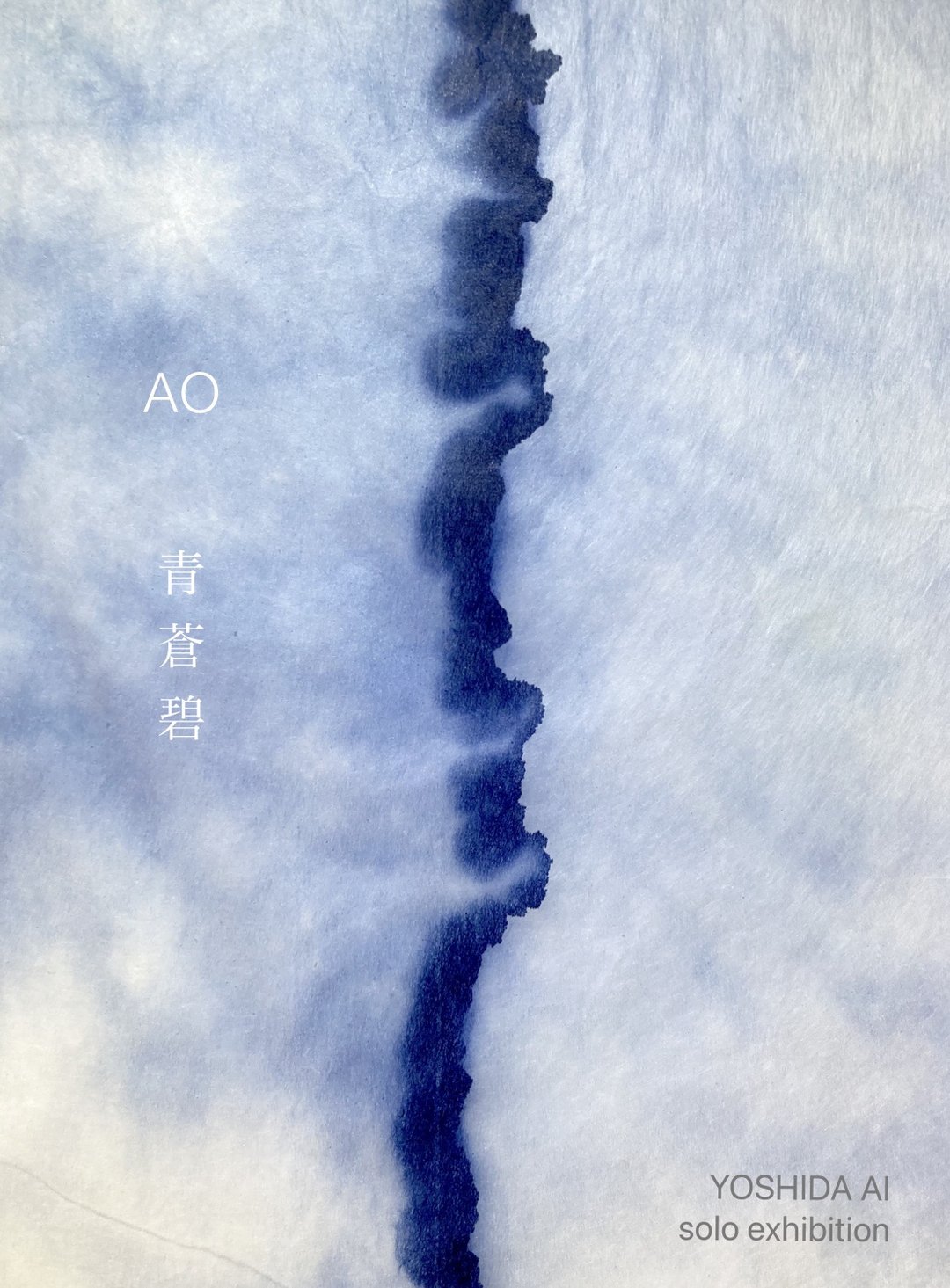
The works here take "ao" — the many words Japanese uses for blue — as their theme, a fitting subject for a gallery on Enoshima, an island ringed by the sea. The pigments are natural. Some come from the leaves of tade-ai, the indigo plant used in traditional dyeing; others from the pressed juice of ao-bana, a variant of the dayflower known as the large-hat flower.
Together they give a range of blues shading into green. Ao-bana has its own history. In Kusatsu, Shiga Prefecture, the culture of ao-bana paper has been carefully protected since the Edo period.
The pigment binds readily with water, so it was used to sketch the underdrawings of yuzen-dyed textiles, and before indigo and Prussian blue came into circulation it served the ukiyo-e artist Suzuki Harunobu as a way to render pale water blues. The colour is fragile. Ao-bana pigment has low lightfastness and fades with time, and as of 2026 only a handful of people still cultivate the plant in Kusatsu.