
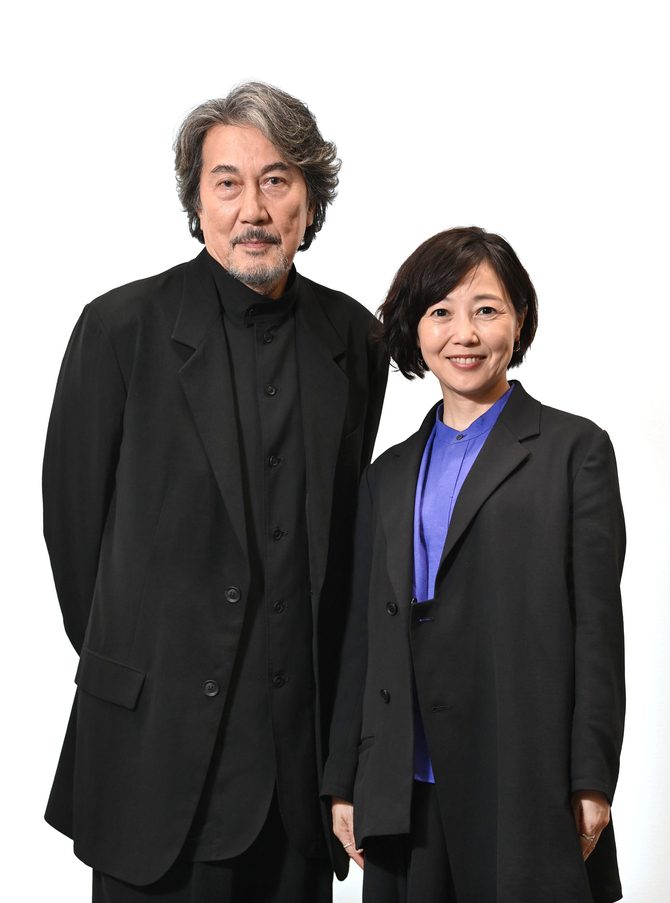
The film "Watashi no Shiranai Kodomotachi" (Children I Don't Know), now in theaters, follows children orphaned by the war from the final months of the Pacific War into the immediate postwar period, tracing the mood of the time and how they survived. Yakusho Koji, who appears in the film, and director Nishikawa Miwa, who made her seventh feature, spoke at length about it in an interview with the Nishinippon Shimbun.
Yakusho starred in Nishikawa's previous film, "Subarashiki Sekai" (Under the Open Sky). In the new film he plays a fisherman who reaches out to children in desperate straits.
He said he had wanted to take part in a Nishikawa film whatever the part, and knew she was writing about children. "If there was a role I could do, I wanted it," he said.
A role carried over from the last film
Nishikawa said the starting point was the childhood of the protagonist in Saki Ryuzo's "Mibuncho," the novel behind her previous film. She had wanted to show that character's early years then, but a two-hour film could not hold them, so she narrowed the story to his middle age.
She was left with the feeling that she had failed to show how the man became who he was. She wanted Yakusho for the new film but wondered whether she should call him in for a small part.
“Sorry, I forced it.”Yakusho Koji, actor
The two share an interest in watching sports, and Yakusho would get in touch during the long writing period, including when track and field events for middle school students were on TV. Nishikawa said his warm words, "Do your best with the writing," encouraged her.
She said the scene where the children in harsh circumstances spend their only human time was, for her, the shortest but most important in the film, and that she decided to ask Yakusho for it.
Playing an adult who is kind
Asked whether the boy Shokichi grows into Mikami, the protagonist of the earlier film, Yakusho noted that Shokichi's tattoo was the more finished of the two. Mikami's was only an outline.
Yakusho said he wanted to watch the children's faces as they ate good food, as a representative of the adults looking on fondly. "Thinking that there were adults who were kind to children in that brutal era is a relief," he said.
Nishikawa said she began from her amazement that the children survived at all, and from her fascination with the life force of children who found every possible way to get by. She first thought of telling it as an adventure story, but as she researched the period she found the suffering too severe to treat so lightly.
She learned that the weakest were given no help as the country turned toward reconstruction, and that adults pushed the children out as an eyesore that recalled the wounds of defeat. She questioned whether it was right for them to be forgotten over time and treated as if they had never existed.
“I think the core of the Japanese mentality, that the weakest are cut off first when something happens, has not changed much.”Nishikawa Miwa, director
She said it could happen again among us at any time, and that she wanted to record it.
Yakusho said it is painful whenever children appear in footage of war, and that there are surely many orphans now, in Ukraine and elsewhere. "It is lonely, why these children are not reached out to," he said.