
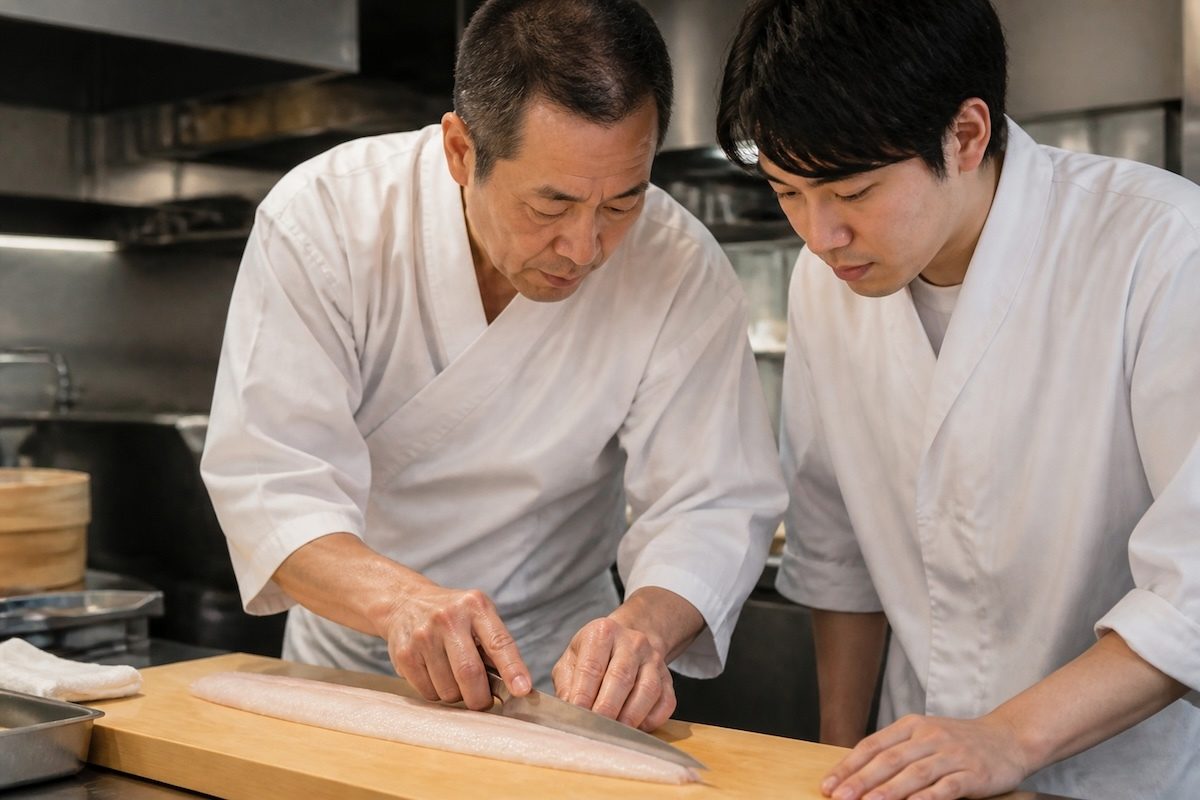
A mass food poisoning at a summer festival in Tokyo has revived a long-running argument about whether it takes 10 years of training to become a sushi chef, and whether the apprenticeship system protects diners or the people already inside it.
In August 2026, 78 people aged 1 to 61 fell ill with diarrhea, abdominal pain and fever after eating at the Azabu-Juban summer festival in Minato Ward, Forbes JAPAN reported. The dish was a chilled crab ramen sold by a shop run by a former martial artist who had become a chef.
Salmonella was detected in patients and in kitchen staff, according to the Minato Ward health center. Three people were briefly hospitalized. The shop was ordered closed for seven days under the Food Sanitation Act, stayed shut afterward, and the owner eventually announced it would not reopen.
Forbes JAPAN noted that the number of victims recognized in the original administrative action was 78, while later reports put the figure at 138, and that it may change again.
An argument about training, attached to a case about hygiene
The outbreak itself pointed to a basic failure of hygiene management. What followed was something else: a well-known business executive's long-standing claim that a sushi chef does not need 10 years of training, and that a talented person wasting that time is a loss to society, was pulled back into circulation on social media.
Some posts tied the two together, arguing the outbreak proved the executive right or wrong. The critic behind the restaurant site Takemashuran, writing for Forbes JAPAN, rejected the link outright.
What the case exposed was not a shortage of training but a lack of elementary knowledge about food safety and a failure of professional ethics, he wrote. Understanding the danger of serving cold crab broth ramen from a street stall in the midsummer sun does not take 10 years of apprenticeship, he argued, and a few hours with a food hygiene textbook would have been enough to avoid it.
Restaurants in Japan are required to follow HACCP, a scientific system of hygiene control. If learning hygiene took a decade, the critic wrote, the Japanese restaurant industry, where untrained part-timers stand in kitchens from their first day, would have collapsed long ago.
He argued that blaming the outbreak on skipped apprenticeship swaps the question, and shrinks it: a chef's skill and a restaurant's service have nothing to do with minimum hygiene rules.
The claim on its own
Set apart from the outbreak, the question is whether the claim that 10 years of training is unnecessary, and wasteful, holds up. The critic said he would take it up, framing it as a question about 食の下積み文化 (shoku no shita-gumi bunka), the culture of years spent at the bottom of a kitchen before being allowed to cook.
The piece as published stops at that question and does not give his answer.
Takemashuran runs a restaurant recommendation site and has close to 20,000 followers on Tabelog, the restaurant review site. Forbes JAPAN described his reviews as covering not only how food tastes but a restaurant's atmosphere, service and philosophy, and said shops he writes about are said to become impossible to book the same day.