
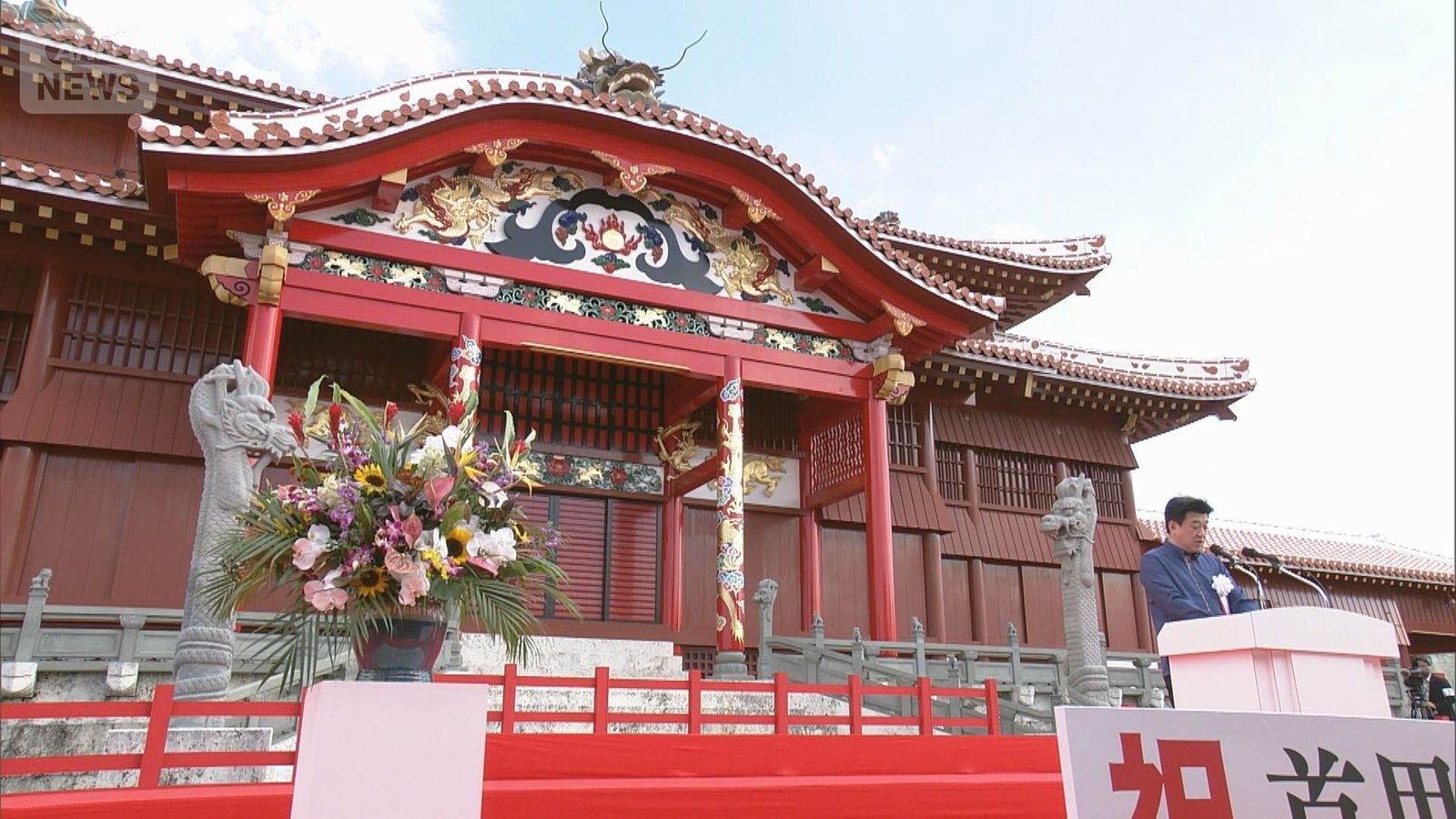
Shuri Castle's main hall, destroyed by fire in 2019, has been rebuilt, and a completion ceremony hosted by the Cabinet Office's Okinawa General Bureau began at 1 p.m. on the 22nd, with public viewing to start on the 23rd.
The fire broke out in the main hall in the early hours of October 31, 2019. Nine structures at the castle and stored cultural properties were lost. Reconstruction work began in November 2022.
Builders reproduced pigments and ornaments on the pillars and walls to bring them closer to their appearance in the Ryukyu Kingdom era. Fire measures were also strengthened, including new sprinklers.
Chief Cabinet Secretary Minoru Kihara told the ceremony that the castle is a source of pride for the people of Okinawa. He called it "an extremely important historical and cultural heritage for our country."
“The burning on October 31 of Reiwa 1 was a tremendous shock.”Minoru Kihara, Chief Cabinet Secretary
Kihara said the government set up a ministerial meeting chaired by the chief cabinet secretary and worked to restore the castle as quickly as possible. Technical reviews were held at the Cabinet Office's Okinawa General Bureau with experts and the prefecture, he said.
Okinawa Prefecture used donations from inside and outside the prefecture to make the red tiles and carvings characteristic of the castle, Kihara said. Municipalities supplied essential materials and held events to build momentum for the revival.
Overseas donors gave materials for ornaments and sent letters of encouragement, he said. The government will keep working with the prefecture, local people and experts on restoring the whole castle as a national government park, he added.
Governor Denny Tamaki told the ceremony that the fire had shocked the prefecture's residents. Seven years on from that deep sense of loss, he said he was deeply moved to reach the milestone.
“Here, the main hall of Shuri Castle has splendidly regained its form.”Denny Tamaki, Okinawa governor
Tamaki credited the restoration to support from residents and people in Japan and abroad, and to swift, extensive efforts by the national government. Craftsmen and engineers brought outstanding skill and passion to the work, he said.
Woodwork, red tiles, lacquer, carving and ceramics all went into the rebuilding. Tamaki described the result as a blend of Okinawan traditional techniques and modern technology, calling it the crystallization of master craftsmanship.
He said the sorrow of losing so much heritage must never be forgotten. The prefecture will strengthen monitoring and initial response, he said, with disaster prevention in mind.
The main hall's completion is a major milestone but not the end of the revival, Tamaki said. Restoration of the north and south halls, and of Nakagusuku Udun, lies ahead.
Old embroidery technique revived
On the main hall's first floor, known as the shimokuguri, the hangings that decorate the throne use a revived Ryukyu embroidery technique. Part of the design was brought back through years of research.
The embroidery shows paired dragons in gold and colorful auspicious clouds. It is also set with glass beads in assorted colors.