
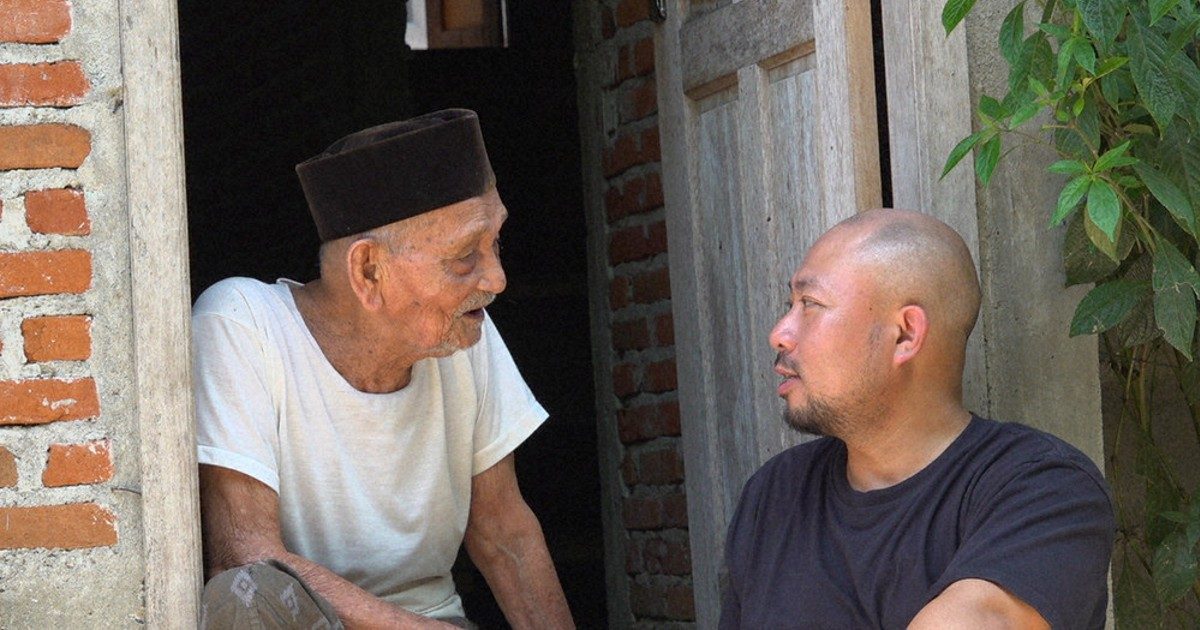
Fighting ends. War damage does not. A documentary opening the question of what Japan did in Indonesia, and what it left there, argues that the suffering passes down through generations.
"Longa's Sea" tells the story of an "unfinished war" from both Indonesian and Japanese perspectives. Haruko Konishi, who directed it, spoke about why she made it.
Her father's words started it. "I think Indonesians are grateful to Japan," he told her.
A father's certainty
In October 1942, during the Pacific War, her father graduated early from Tokyo University of Commerce, now Hitotsubashi University, was called up by the army and posted to Indonesia. There he instructed young men in a local defense volunteer corps.
After Japan's defeat, those young men defeated the Dutch, who had tried to keep their colonial rule over Indonesia, and won independence. That, her father believed, was why Indonesians were grateful.
She was not convinced. "Is that really true? I'll see it with my own eyes," she recalled deciding.
A grandson's search
Konishi began reporting in 2000. In the course of it she met Mario Kuroiwa, the grandson of a Japanese soldier left behind in Indonesia.
His grandfather, Toru Kuroiwa, served as a special police captain in Aceh, in northern Sumatra. His job was to suppress residents involved in the anti-Japanese movement.
After the defeat, Kuroiwa threw himself into Indonesia's war of independence and married a local woman, Ema. In 1955 he returned to Japan, leaving his wife and two children, including four-year-old Hendri.
“For a long time Hendri lived believing he had been abandoned by his father.”Haruko Konishi
Who was her father, and who was his grandfather? Why did he go to Indonesia, and what did he do there after the defeat? Why did he leave his wife and children? The film follows the questions the families are still asking.
The article in the Mainichi Shimbun is truncated at that point, with 816 of its 1,406 characters behind the paywall.