
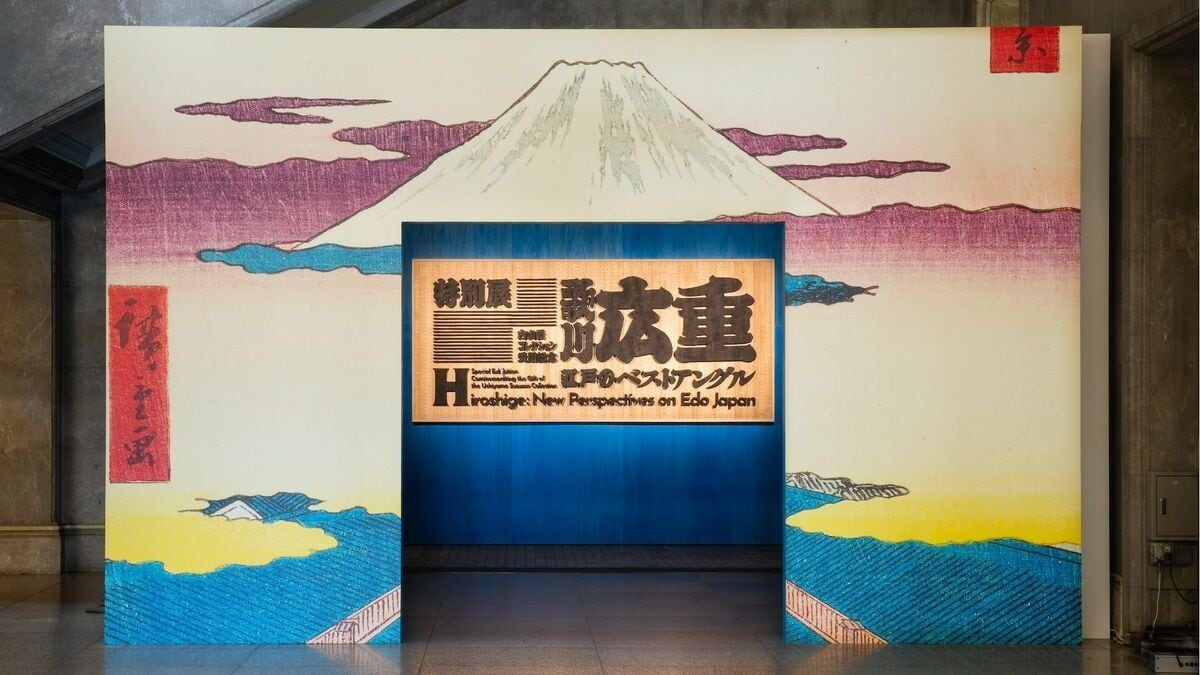
An exhibition of Utagawa Hiroshige's landscape and bird-and-flower prints has opened at the Tokyo National Museum, built around the three series that made his name: the Fifty-three Stations of the Tokaido, the Sixty-nine Stations of the Kiso Kaido and One Hundred Famous Views of Edo. Titled "Utagawa Hiroshige: The Best Angles of Edo," it presents all the prints in the three series, divided into three periods.
Hiroshige (1797-1858) built his reputation on landscapes that carry the changing of the seasons and on vividly colored bird-and-flower pictures. The exhibition draws on the three series for its core and adds other landscapes and bird-and-flower works.
Hokusai and Hiroshige, side by side
Among the ukiyo-e artists who worked in the Edo period, the two names that divide landscape printing between them are Katsushika Hokusai and Hiroshige. Hokusai has Thirty-six Views of Mount Fuji and Hiroshige the Fifty-three Stations of the Tokaido, and both are held in high regard in Japan and abroad.
Their approaches differ sharply. Hokusai's landscapes, strictly speaking, can be called something other than landscapes: he altered the actual scenery heavily, rebuilding it on the page in favor of form, so that the prints read as creations inspired by real views. Hiroshige kept the character and mood of each place and built scenes with a sense of presence.
His views hold together with fewer of the inconsistencies that invite a viewer to object that Mount Fuji could not be seen from a given spot. He did not simply copy what was in front of him, though. He thought about how to frame a view, and the exhibition's title casts him as an artist in pursuit of the best angle.
The eye of a camera
The One Hundred Famous Views of Edo, the last of the three series, is described as close in method to modern photographic technique. Vincent van Gogh collected 13 prints from the series.