
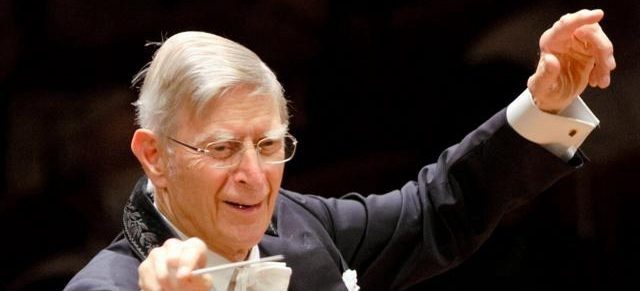
Swedish conductor Herbert Blomstedt, who worked at the top of the classical music world for more than 70 years, died on the 4th in Gothenburg, Sweden. He was 99. The Gewandhaus Orchestra in Germany, which he once led as music director, announced his death.
Blomstedt drew faithful readings of composers' intentions from the score while devoting energy to reviving once-neglected works. He recorded the complete symphonies of Danish composer Carl Nielsen, among other projects, and helped drive a worldwide reassessment of Nielsen's music.
Born in the United States, he moved to his parents' native Sweden at age 2. He studied at the Royal College of Music in Stockholm and elsewhere, and trained under Leonard Bernstein at the Juilliard School in New York. He went on to study contemporary music in Germany and Renaissance and Baroque music in Switzerland, building a broad base of musical learning.
Dresden, San Francisco and the Grammys
Blomstedt made his full debut as a conductor in 1954. From 1975 he was chief conductor of the Staatskapelle Dresden, then one of East Germany's leading orchestras, and made historic recordings of Beethoven and Schubert. In 1985 he became music director of the San Francisco Symphony. He won the US Grammy Award several times.
His ties to Japan ran deep. From his first appearance with the NHK Symphony Orchestra in 1981, he returned to the podium regularly, and he took part in charity concerts supporting recovery from the Great East Japan Earthquake.
Honors and a final canceled visit
In 2018 Japan awarded him the Order of the Rising Sun, Gold Rays with Neck Ribbon, for his contributions to the country's musical culture. This September, the Praemium Imperiale, Japan's global arts prize, announced he would be a laureate.
The NHK Symphony Orchestra gave him the title of laureate honorary conductor, and he appeared with the orchestra frequently. He had been due to come to Japan in October but withdrew in June because of poor health.