
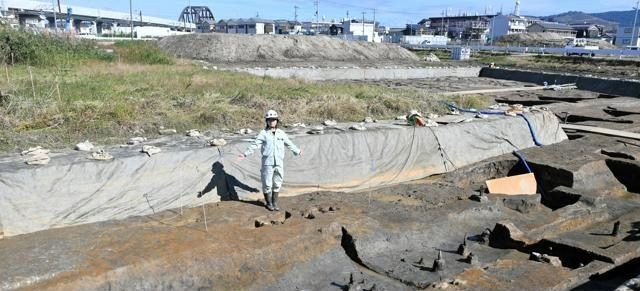
Archaeologists have found the remains of a crossroads at the Heijo-kyo site in Yaoi 2-chome, Nara, in the ruins of a residential block known as Sakyo Rokujo Sanbo, dating to the late Nara period. The Nara Prefectural Kashihara Archaeological Institute announced the find on Wednesday.
Drainage ditches are thought to have run along both sides of every road running east-west and north-south through Heijo-kyo. At this site, the ditches also crossed the road surface inside the intersection, the institute said.
The discovery suggests that even in areas away from the capital's center, the city may have been laid out with drainage in mind as part of a detailed plan.
A capital on a grid
Heijo-kyo became the capital in 710, when the court moved from Fujiwara-kyo — also called Aramashi-no-miya, in present-day Kashihara. Including its outer extensions, the planned city stretched about 6 kilometers east-west and 5 kilometers north-south.
Suzaku Oji, the broad avenue running north-south through the center, divided the capital into Sakyo to the east and Ukyo to the west. East-west roads were called jo and north-south roads bo, and the city was divided into a grid of blocks.
Each block, also called a bo, measured about 533 meters on a side. Three roads ran in each direction through it, dividing the block into 16 smaller plots known as machi or tsubo.
The institute will hold an on-site briefing on the excavation on the 7th from 10 a.m. to 2 p.m., to go ahead in light rain.