
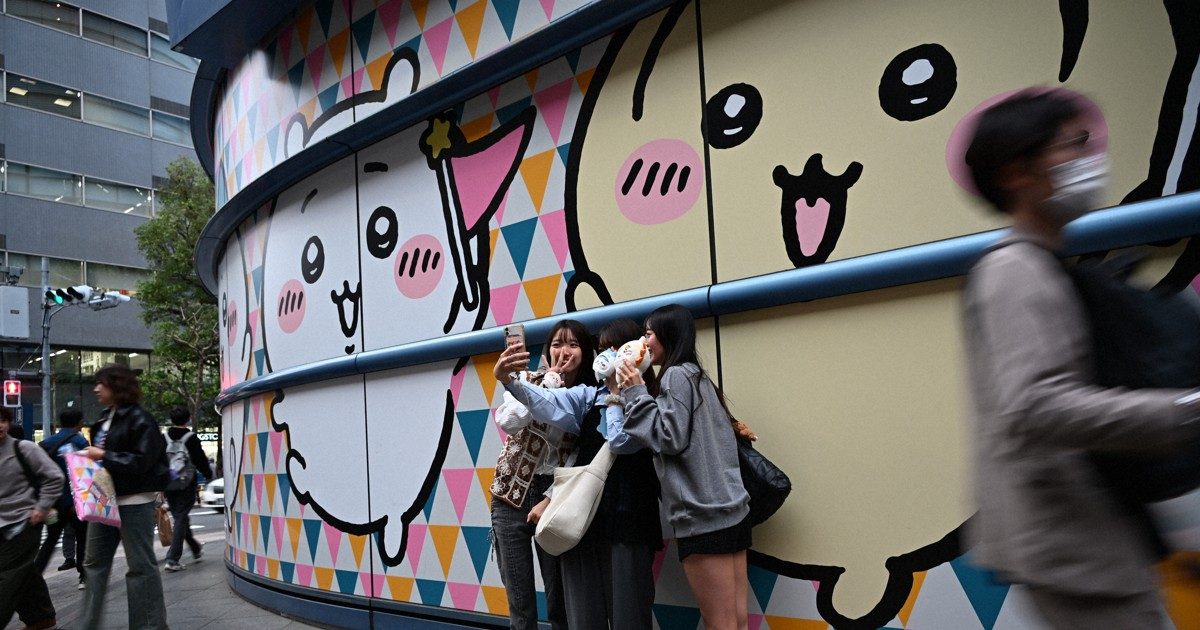
The anime film "Chiikawa: The Secret of the Mermaid Island," released in July, has drawn more than 12 million moviegoers and earned ¥18.49 billion at the Japanese box office as of the 25th, according to the box office data firm Kogyo Tsushinsha. It is the year's biggest hit.
The boom has spread across Asia, and the character is gaining popularity in the United States, where the film has not been released.
"Chiikawa reflects the anguish of young people around the world," Jason Makoto Chang, a 60-year-old professor at the University of Hawaii-West Oahu who studies East Asian popular culture, said in an interview with the Mainichi Shimbun.
Chang discussed the roots of Chiikawa's global popularity and what the character says about contemporary society.
A dark story behind a cute face
Chiikawa began in 2020 as a manga by the illustrator Nagano, serialized on X, under the title "Chiikawa: Something Small and Cute." Chang said a manga artist he knows in Japan recommended it to him two or three years ago, telling him it looked cute but had a fairly dark story, and that the gap was what made it interesting.
He did not watch it right away. But he visits Japan about three times a year, and on one trip he walked into a Kiddy Land character shop in Harajuku, where the store was packed with people after Chiikawa goods, including many Chinese-speaking tourists. The scene made him wonder what the character was, and he went on to watch the anime and read the manga.
"I was surprised at how interesting it was," he said. "And as a scholar I noticed something right away."
The cute character, he said, is doing day labor — or in modern terms, working in the gig economy, taking one-off jobs arranged over the internet.
The full interview, which runs to 3,697 characters, also covers whether Chiikawa's setting resembles the day-laborer districts of San'ya and Nishinari, the decisive differences between Chiikawa and Doraemon, how the work overlaps with modern consumer society, the challenges young people share across Japan, China and South Korea, and the new kind of hero American society is looking for.