
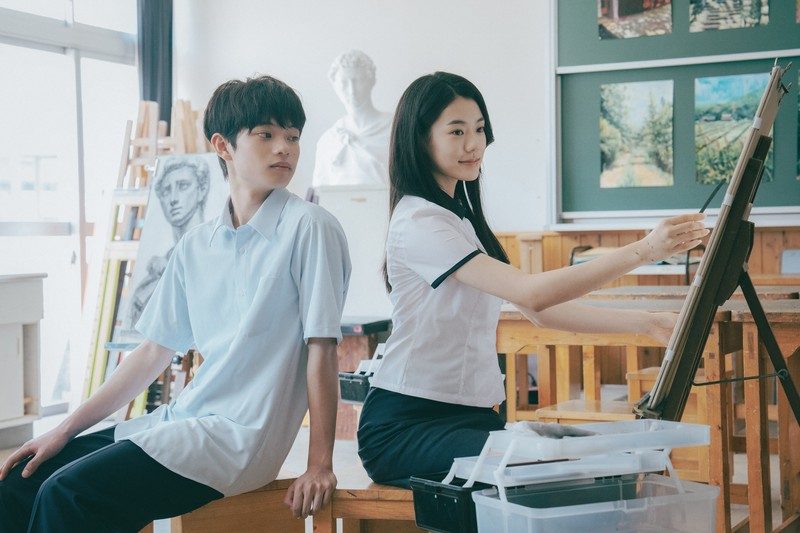
The hero of "3ミリの恋" (3mm no Koi) is a 17-year-old Japanese boy, Tatsuhiko, played by Soya Kurokawa, who lives in Karatsu, Saga Prefecture. The girl, Yunsul, played by Kim Ji-an, comes from Busan, South Korea, and transfers into his high school as an exchange student. The two meet there.
They speak different languages and have learned different histories. But those differences do not decide who they are to each other in advance. Neither is a diplomat representing a nation, and neither has been handed the job of settling the past. They are simply two young people who were moved by each other.
That such an ordinary thing still needs saying, in a romance, is where the Mainichi Shimbun's critic Hong Sang-hyun begins.
A genre that carried the weight of atonement
Earlier Japanese and Korean films on love across the divide arrived with conditions attached. In "Pacchigi!" (2004), romance became entangled with a demand for atonement for history. In "Chirusoku no Natsu" (2003), xenophobia and patriarchal authority blocked the feelings of the young.
In the latter, the Japanese girl's father, played opposite Mizutani Hiori, is an unnamed singer who drifts between bars serving Korean customers. A man granted little authority by society brings out ethnic hierarchy in front of his daughter, and turns violent.
The setup creates a twist: the film criticizes xenophobia while trapping a Japanese girl who loves a Korean in a story of social deficiency and unhappiness. Why did love between Japanese and Koreans have to carry the ending of atonement or defeat before it had even begun?
Not a slogan, a life
"3mm no Koi" does not need those worn-out conditions. Yunsul's father serves the boy from Japan milmyeon, a Busan specialty, and her mother provides a bed and breakfast. A stranger the boy meets in Busan also reaches out to him. They are simply being hospitable to the person in front of them, and that is more persuasive than any slogan about reconciliation between peoples.
Not every adult is unconditionally tolerant, and conflict does exist. What matters is that the film does not convert that conflict into hostility based on nationality.
Yunsul's great-grandfather died in an accident while working in a coal mine in Karatsu during the years Korea was under Japanese colonial rule. Tatsuhiko, who knows little about Japanese rule, says something that wounds her. When he later learns of the astonishing connection between their ancestors, he apologizes for his insensitivity.
It is not a political gesture. Yunsul, taking in his feeling, quietly prays for the happiness of the dead. The two speak in their own words and come to understand each other's pain.
Knowing the wounds of the past does not mean a new love has to trace the same shape. A wound in history is also, for someone, a concrete loss. To understand history is to receive another person's suffering as one life rather than as an abstract national slogan.
Who loved whom, who was lost, what was remembered for a long time. The feelings of individuals who lived inside large history are left behind and handed to the next generation. The film's universal humanism is not the optimism that erases history. Acknowledging a state's responsibility and demanding that individuals alive now re-enact past enmity are separate matters.
The length of a fingernail
The "3mm" of the title pulls the distance of politics and history down to personal experience. Tatsuhiko rereads the words "Japan-Korea Annexation" in his history textbook and measures the distance between Karatsu and Busan with a ruler. On the map it is the length of a fingernail.
The Busan he reaches, though, is a huge city where finding even one person is daunting. The camera that stayed close to faces in Karatsu holds the boy alone in a vast space in Busan.
For a boy who has begun to understand the world through love, Busan is no longer an abstract foreign country, and Karatsu is no longer just an unfamiliar place name to Yunsul. Love does not erase borders in an instant. It only teaches, through the body, how wide the world beyond them is and how full of the unknown. Crossing the sea takes a boat, and understanding another language and another memory takes time.
That does not make love impossible. For the two, who meet again after time has passed, the 3 millimeters is no longer a number on a map but the length of the time they crossed together.
The film lingers on the two learning to pronounce each other's names. A name is the simplest way to call someone as one person who cannot be swapped for anyone else. Yunsul works on the Japanese "tsu"; Tatsuhiko works on the Korean "ru." The small effort of learning an unfamiliar sound is more intimate than any grand declaration.
When the two finally meet and embrace, the film does not claim to have achieved reconciliation between Japan and Korea on anyone's behalf. It leaves a smaller, more fundamental fact: beyond the border, people with their own names and faces are living.
Tatsuhiko did not go to Korea. He went to Yunsul. And there he met people.