
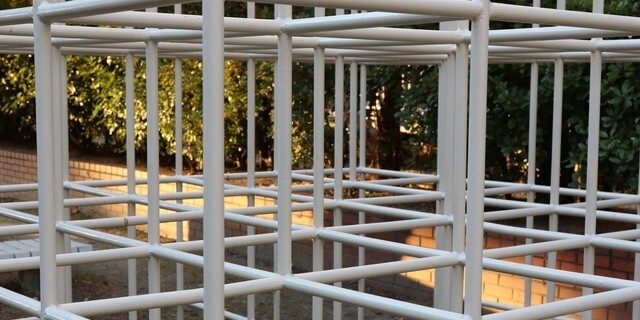
Ten years ago today, a wooden exhibit built by students caught fire at Tokyo Design Week, an event held at Meiji Jingu Gaien in Shinjuku Ward, Tokyo. A 5-year-old boy playing inside died. His father, who went in to rescue him, and another man were burned.
The exhibit was a jungle-gym-like frame about 3 meters tall, stacked from square cedar beams, made by a volunteer group of students at Nippon Institute of Technology. Large amounts of wood shavings were fixed to the frame and spread on the ground as decoration. Children were allowed inside to play, and on a Sunday the piece was crowded with them, pulling at the shavings, throwing them and carrying them around.
How the fire started
Around 5 p.m., with the sun getting low, a student placed a floodlight inside the structure and switched it on. It used an incandescent bulb. About 15 minutes later the area around the light suddenly brightened, and a large flame rose immediately after. Fire spread through almost the whole piece at once.
The frame's strength had been studied on the assumption that children would climb up and down it and pass through it, and its corners were rounded. Falling and injury had been considered. Fire safety had not.
That an incandescent bulb gets hot is not specialist knowledge. Anyone who has used one knows it. People involved with the piece were aware of the danger: the university said only LED lights were planned, and the floodlight was equipment brought in for setting up at night. The university president said at a press conference that the light had been lit inside the piece in a pot-like container, so the bulb would not touch the shavings directly. The appeals court found that the student leader, when considering lighting during setup, had taken care to keep the incandescent lamp away from the shavings because it gets hot.
In a reconstruction experiment accepted by the court, leaving the floodlight switched on was not enough to start a fire. Ignition came when a certain amount of shavings stayed in contact with the center of the bulb's surface. The court found that shavings moved by the children came to rest on the lamp's wire guard, and some slipped through the gaps and stayed against the bulb.
The danger, then, was not the hot equipment or the flammable material on its own. It arose from putting the two together in a space where children were playing.
Two students in the dock
Two students who were on monitoring duty that day were charged in the criminal case. The article does not say what sentences they received. It asks why only the first-year student on duty was convicted, and what responsibility went unexamined in court.
The piece was built by students, but it stood inside an event venue, and the article's question is aimed past them: at who approved the exhibit, who set the rules for the site, and why fire risk was never part of the planning for a structure meant for children to enter.