
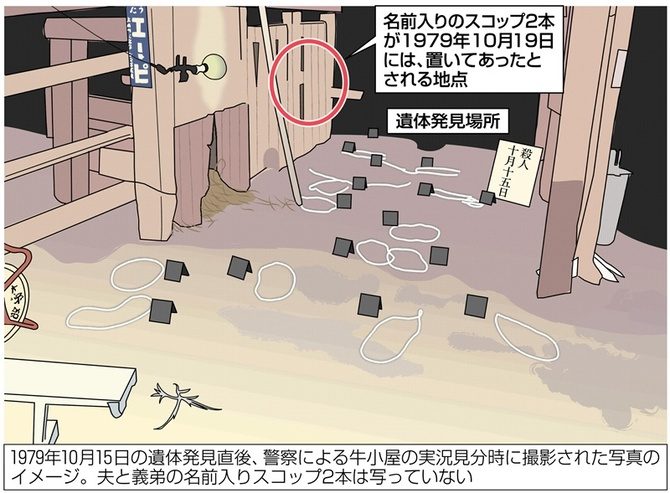
A shovel that a final verdict found was used to abandon a body in the 1979 Otsuki case in Kagoshima Prefecture was not at the spot where it was later found on the day the case came to light, four days earlier, investigation records show.
The records were submitted to the Kagoshima District Court as new evidence in the fifth retrial request by Ayako Haraguchi, 99, who served time after being convicted, the Nishinippon Shimbun reported. Her defense team argues the shovel appeared and disappeared in step with the confessions of a relative convicted as an accomplice, and that it is strongly suspected of being fabricated evidence.
Under the final verdict, Haraguchi, her husband at the time and her younger brother-in-law strangled the victim on October 12, 1979. The four, including a nephew, were found to have buried the body before dawn the next day in a compost heap in the cattle shed at the victim's home.
The four days between discovery and the shovels
The body was found on October 15, 1979, and the case came to light. A photograph of the compost heap taken that day during an on-site inspection shows no shovel.
The inspection report compiled by prefectural police lists trace items found near the heap, including two cigarettes, 20 footprints, hair and some pubic hair. It records no shovel.
Investigation records state that on October 19 the victim's wife found one shovel bearing the name of Haraguchi's husband and another bearing her brother-in-law's name in a passage by the compost heap. She turned them over to prefectural police voluntarily, and a diagram showing where the two lay is attached.
The two shovels that were not at the compost heap when the body was found had appeared four days later.
Confessions at the center of the verdict
The confessions of the relatives convicted as accomplices were the mainstay of the guilty verdict. As of October 19, the husband and brother-in-law had told investigators the killing was something "the two of us did."
"It is strongly suspected that investigators brought the shovels in after the 15th to match this confession," the defense team argues.
Prosecutors requested the two named shovels as evidence, along with three others, at the first-instance trial that began at the end of 1979. They later withdrew the request for the shovel bearing the brother-in-law's name.
The first-instance ruling recognized the shovel bearing the husband's name, and another seized at Haraguchi's home, as property used in the crime of abandoning the body.
Former judges and prosecutors say it is rare for prosecutors to withdraw evidence they have already requested.
Trial records show the confessions of the three relatives went through repeated changes before settling on a version in which Haraguchi brought the shovel from her home. No statement said it was brought from the brother-in-law's house. The three brothers' homes stood close together, each with a cattle shed and its own shovels.
“Evidence changes in step with the statements investigators were able to obtain. The two named shovels are strongly suspected of being fabricated, and if so, the credibility of the relatives' confession that Ayako brought the shovel from home is also undermined.”Mitsuhide Yahiro, lead defense lawyer
Earlier rulings and police explanations
In its 2002 decision on the first retrial request, the Kagoshima District Court said doubts remained over how the shovels came into police custody, and allowed the retrial to begin.
Prosecutors questioned two former police officers in 2003 and 2004 about receiving the shovels from the victim's wife in 1979. In the records, the former officers explained that the shovels had been used to dig up the body and so were moved around, and that it would be no surprise if they were later placed in their respective spots and found.
The defense argues that the Criminal Investigation Code, which sets standards for police investigations, requires a crime scene to be preserved as it was. If the officers' explanation is accurate, the shovels should be excluded as illegally obtained evidence, the defense says.
Prosecutors have not yet made arguments about the shovels in the fifth request, according to the defense team. Their rebuttal to other new defense evidence is expected in January or later, and the timing of a decision is not in sight.