
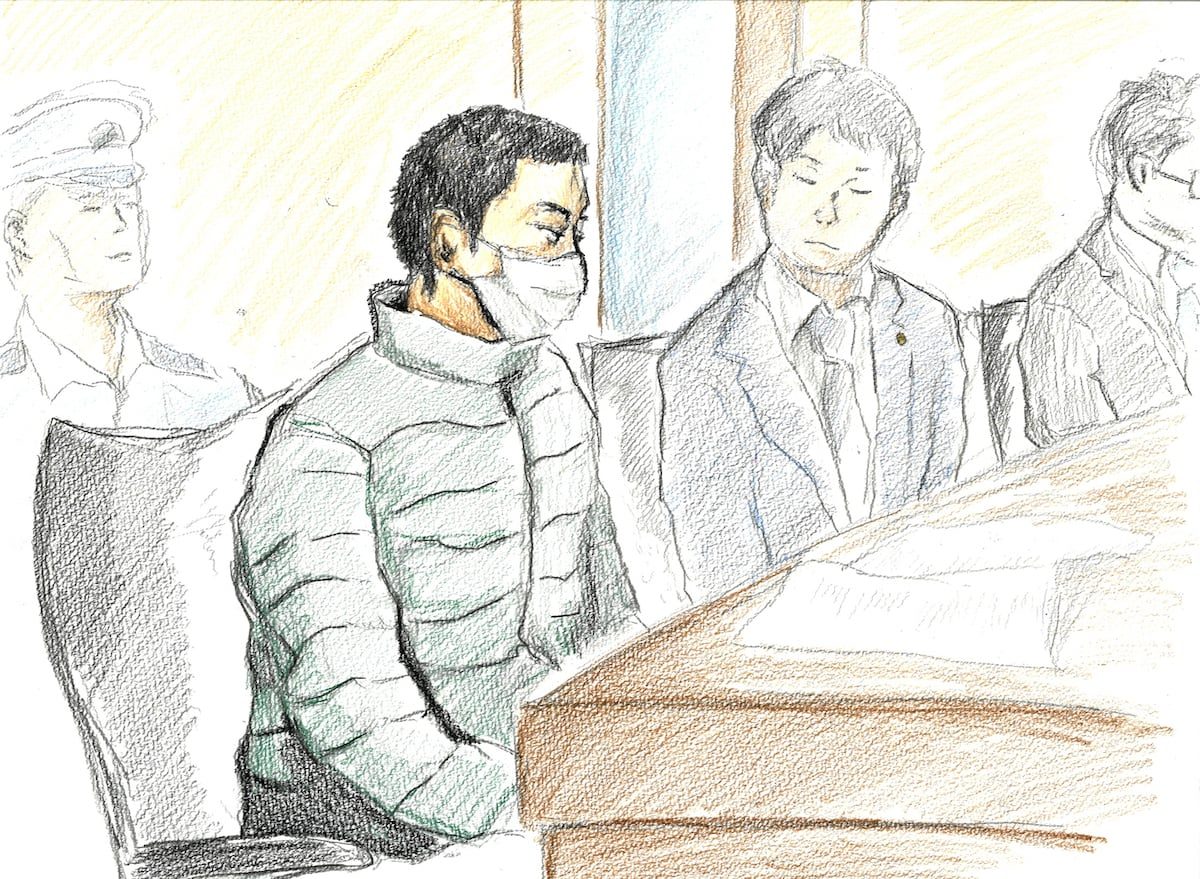
A 30-year-old man accused of trying to kill seven elementary schoolchildren by driving into them in Osaka told the opening day of his lay-judge trial that he will say nothing, and that he will not ask for a lighter sentence.
Yuki Yazawa, of no fixed occupation, is charged with attempted murder over the May 1 incident last year in Nishinari Ward, where children were walking home along a street beside their school.
At the Osaka District Court on the 9th, presiding judge Akihiro Motomura opened the trial. Yazawa stayed silent for a while when asked to enter a plea.
He then said: "Thinking that my words could have a negative effect on the children's mental state, it is better that I say nothing. I will keep silent from now on. I will not seek a reduction" in sentence.
Prosecution case
According to the indictment, Yazawa intended to kill children indiscriminately on the afternoon of May 1 last year. Near Osaka Municipal Senbon Elementary School, prosecutors say, he accelerated a rented sport utility vehicle to 19 kph and struck seven children in the second and third grades.
He then drove over the bodies of several children who had fallen, breaking their bones, according to the charge.
In its opening statement, the prosecution said Yazawa had tried to kill himself twice after falling out with his family, and both attempts failed. He then "thought he wanted to die for certain, and that meant being sentenced to death," the prosecution said.
Prosecutors said he traveled from his home in Tokyo to Osaka on April 29 last year and rented the car. Over the two days from April 30 until the incident, he drove around elementary and junior high schools, nurseries and leisure spots including the Osaka Aquarium Kaiyukan, looking for a chance to carry out the attack, they said.
Defense cites autism spectrum disorder
The defense said Yazawa has autism spectrum disorder (ASD), a developmental condition, and argued that if it affected his motive, that should be weighed in sentencing.
Yazawa appeared in court in a down jacket and a face mask. The defense described how he came to think strongly about wanting to die.
He grew up in Saitama Prefecture. From his elementary school years he repeatedly acted on impulse, throwing sand at friends and pushing them from behind while they carried others on their shoulders, the defense said.
Yazawa did not understand why he behaved that way, and in junior high school he "stopped dealing with people," according to the defense.
The wish to die had already taken root in his childhood. He still went on to university, obtained a national qualification as a radiological technologist and found work at a hospital.
A supervisor's statement read aloud in court said that while his communication skills were poor, "his work was precise, and we could leave him to it with peace of mind."