
WAJIMA, Ishikawa Prefecture — A man whose wife and eldest daughter were killed when a neighboring building toppled onto his home in the January 1, 2024, Noto Peninsula earthquake has sued the building's owner and the state for about ¥200 million in damages, his lawyers said.
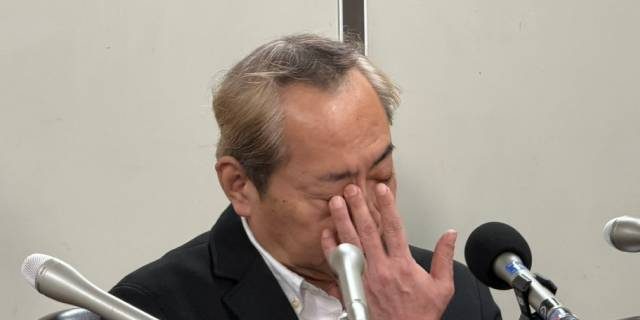
Kenji Kusunoki, who ran an izakaya pub with his wife, filed the suit with the Tokyo District Court on November 5 against Goshimaya Co., which owned the seven-story Goshimaya Building, and the government. At a news conference in Tokyo with his lawyers, he said he still cannot believe the quake took the two.
“The building fell, and that is why the two of them were crushed and died.”Kenji Kusunoki, plaintiff
Before the quake, Kusunoki and his wife used to joke that if a tsunami came, they would simply flee to the neighboring building, he said. The Goshimaya Building was the one they counted on.
'I never dreamed it would come down on our house'
According to the complaint, the family lived in a building immediately east of the Goshimaya Building and ran the pub together. Kusunoki recalls the moment the shaking began.
“I remember clearly that something enormous pressed on the house while it was shaking, and it collapsed.”Kenji Kusunoki, plaintiff
Kusunoki briefly lost consciousness. When he came to, he was in the ground-floor shop area with his younger son and younger daughter. His wife, Yukari, then 48, and eldest daughter, Shuran, then 19, were trapped deep in the debris and could not move. No rescue came amid the confusion, and the two are believed to have died by January 3 at the latest.
“At first I thought the earthquake had crushed the house. I only heard later that the neighboring building had fallen. I had assumed buildings were solid, so I never dreamed one would come down on my own home.”Kenji Kusunoki, plaintiff
Piles 'just resting' on the foundation
The Goshimaya Building was built in 1973 and had seven stories. Goshimaya used it to manufacture and sell lacquerware, according to the complaint. In a report published in December 2025, the Ministry of Land, Infrastructure, Transport and Tourism concluded it was the first case in Japan of a reinforced-concrete building on pile foundations toppling in an earthquake.
Akihiro Shima, one of Kusunoki's lawyers, used that report to explain the collapse. A foundation section called a pile cap sits above the piles. In the Goshimaya Building, he said, the two were not joined, leaving the structure effectively stacked on top of the piles. The older ready-made concrete piles were also fragile, and the spacing between columns was sparse and unevenly distributed, so the building's weight concentrated on one side as it shook.
“It is built in a way that makes you wonder how such a building could exist.”Akihiro Shima, lawyer for the plaintiff
The suit against Goshimaya rests on Article 717, Paragraph 1, of the Civil Code, which holds the occupier or owner of a structure on land liable when a defect in that structure causes harm to another person. Shima said the failure to carry out a seismic diagnosis or reinforcement was not the issue.
“The problem is not that they did not conduct a seismic diagnosis or retrofit. If a building has a defect and that defect causes damage, the occupier or the owner bears responsibility.”Akihiro Shima, lawyer for the plaintiff