
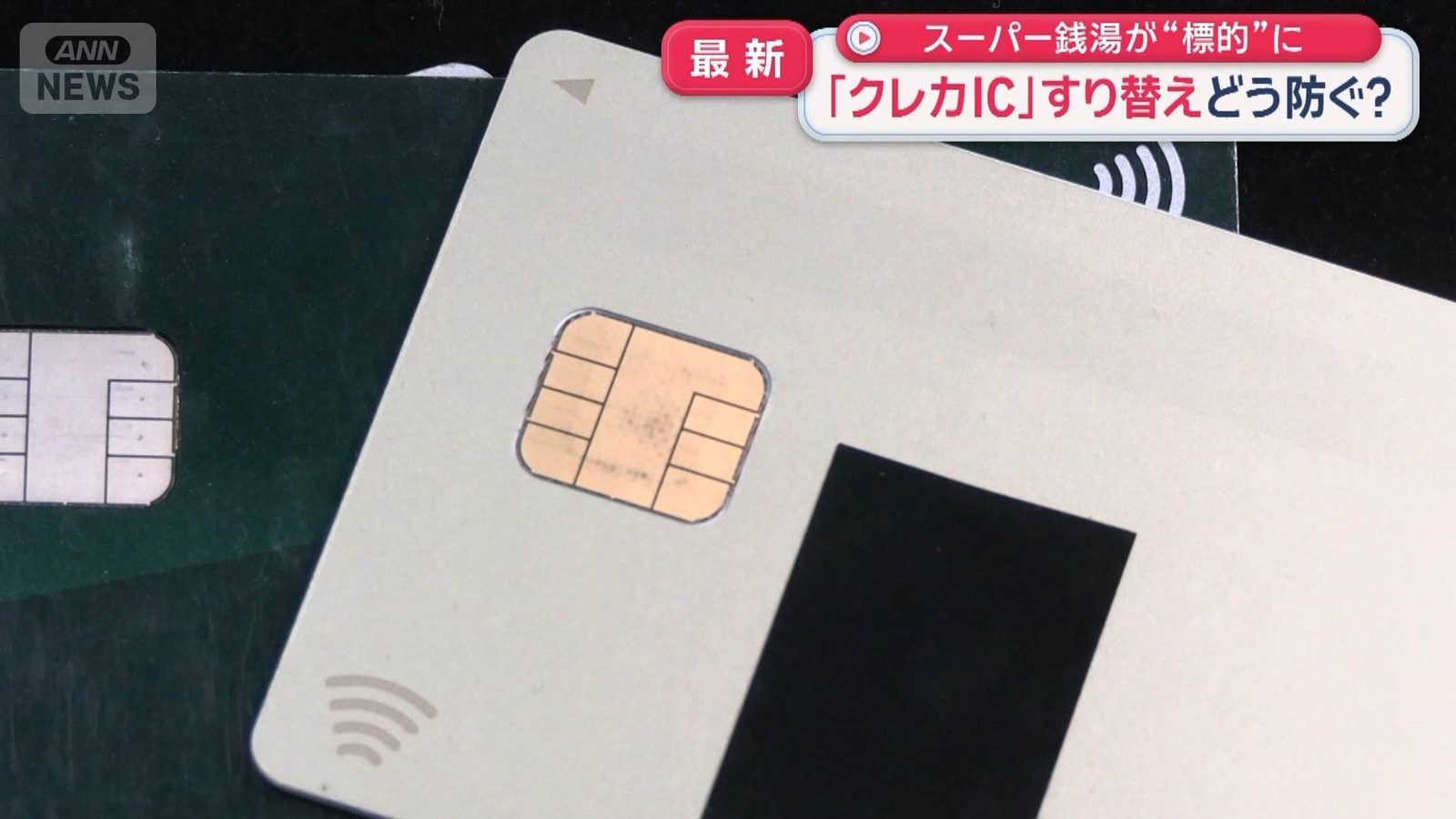
Thieves posing as customers at bathhouses across Tokyo, Chiba, Saitama and Kanagawa are prying the IC chips off credit cards and pressing fake ones in their place, with about 100 such swaps confirmed at Kanto bathhouses and losses running into millions of yen, according to reports.
Police say the perpetrators enter the facilities posing as customers. In the changing rooms they first check on other bathers, then move.
They carry a large set of duplicate keys prepared in advance, seized in the investigation, with numbers written on them. The numbers match locker numbers, and the perpetrators pick out the matching key and quietly open the locker.
The target is not the card itself. The perpetrator peels off the IC chip attached to a customer's card and replaces it with a counterfeit one.
Chiba Prefectural Police arrested Zhang Lizhi, a 46-year-old Chinese national, on suspicion of entering a bathhouse in the prefecture with the intent to steal credit cards and other items. Police believe he belongs to an international theft group. He has denied the charge, saying he knows nothing about it.
How the duplicate keys were made
A bathhouse in Tokyo that has not been hit in this spate of thefts has its own theory. Its operator told a broadcaster that a locker key was probably carried outside once and copied there.
That bathhouse suffered a duplicate-key incident about 10 years ago. Since then it has used shoe-cabinet keys as a safeguard.
“We swap the shoe-cabinet key for the locker key.”Takaya Shinbo, representative of Daikoku-yu
To leave the bathhouse wearing their shoes, customers must hand back the locker key and take the shoe-cabinet key in exchange. The arrangement keeps locker keys from leaving the building.
Asked about the effect, Shinbo said there had not been a single case at his bathhouse since the change.
What customers can do
Mika Kyoshi, a crime-prevention specialist, said a swapped chip is hard to spot without a careful look.
“After using a card at a public facility, for example, check at home whether anything about it looks wrong — whether the IC chip is lifting or peeling, whether the card is scratched. Checking your card statements matters too.”Mika Kyoshi, crime-prevention specialist
If a customer notices something suspicious, the card can be stopped before it is used fraudulently, she said.