
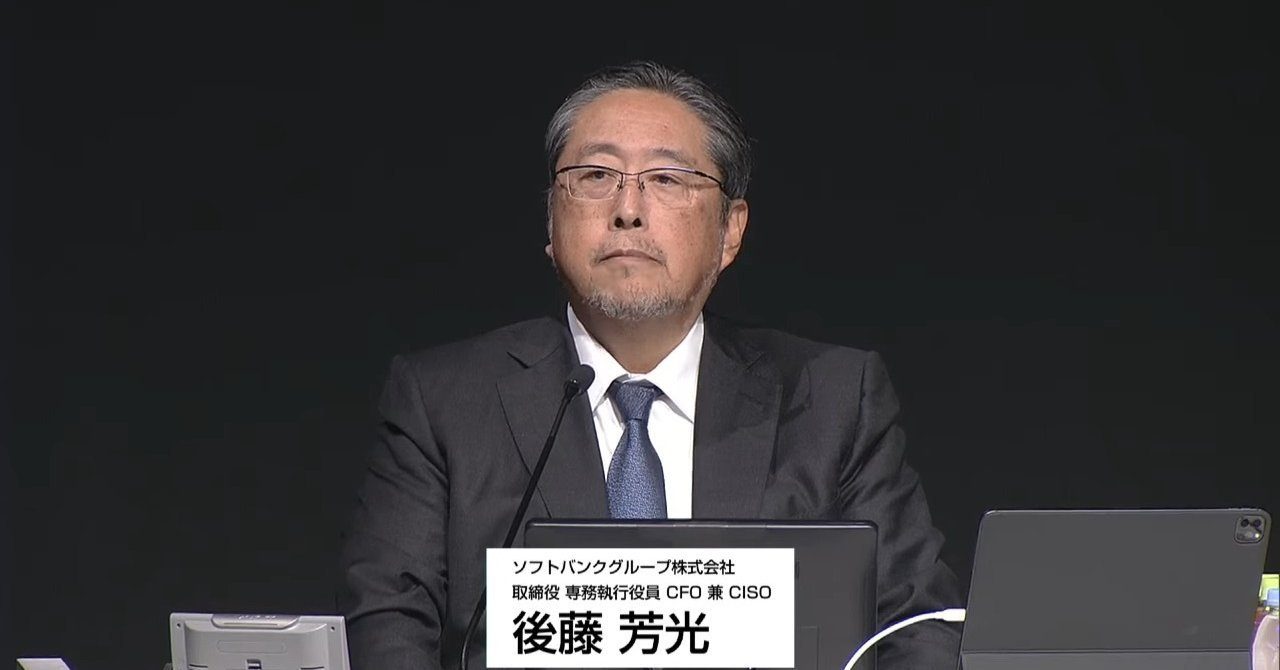
SoftBank Group CFO Yoshimitsu Goto on Tuesday rejected Elon Musk's claim that the group is in default on turbine orders, calling it "completely groundless," as the company reported a net loss of more than ¥1 trillion for July-September.
Musk, the CEO of SpaceX, posted on X on November 6: "SoftBank is defaulting on their turbine orders." The post was a reply to a thread about the sale of data center loans. Turbines are the equipment used in power generation facilities that supply electricity to data centers.
Asked about the post at an earnings briefing on November 10, Goto said: "I have no idea at all why that kind of tweet was made." He added, "We are not in anything like default," and said AI infrastructure plans will proceed as scheduled.
Share slide cuts holdings value by about ¥15 trillion
The global stock sell-off since the end of September has hit the value of SoftBank Group's holdings. Goto said NAV — net asset value, or the value of its shareholdings and other assets minus liabilities, which the group treats as a key metric — stood at ¥59.8 trillion at the end of September.
Reflecting share prices and exchange rates as of November 9, that figure falls to ¥44.7 trillion, he said. The loan-to-value ratio, which shows borrowing as a proportion of asset value, remains well below the 25% ceiling the company sets.
Goto noted that some companies born during the dot-com boom grew into today's hyperscalers — the giant IT firms — and said: "Without swinging between hope and despair over short-term ups and downs, we want to look to the future vision and keep moving forward."
Asked whether the fall in NAV and rise in LTV would push the group toward a defensive investment stance, Goto said the environment is not one of "charging ahead aggressively with investment." He said it was natural to discuss watching developments for a while, and that managing LTV within 25% works by balancing accelerator and brake. Over the medium and long term, he said, the group will press ahead thoroughly with preparations for AI.
Circular funding and hyperscaler credit
Goto was also asked about concerns that money is circulating among AI-related companies through investments and deals. SoftBank Group has invested in OpenAI, OpenAI rents data center capacity from subsidiary SB Energy, and Nvidia backs OpenAI on credit.
Lenders ultimately look at where the money will be repaid from, Goto said, and what is being questioned now is the creditworthiness of the hyperscalers. He described them as "companies whose credit is far, far above ours," and said lenders are putting up money because they judge there is no risk. The idea that circular funding is itself a risk needs calm analysis, he said.
Midterm results and data center delays
Several questions touched on the US midterm elections held on November 3, in which the Democrats retook both chambers of Congress. Asked about the effect on the group's US data center business, Goto said he is "not really in a position to comment on the election results." He said the various views on data centers were understood before the election, regardless of the outcome.
Opposition to data center construction has spread across the US over concerns about electricity bills and water use. SoftBank Group says it has long stressed communication with local communities. It has answered worries about higher power bills by developing its own electricity for data centers, including 900MW of generating capacity in Milam County, Texas, comparable to the data center under construction there. It also reuses water to keep consumption to a minimum.
Asked whether projects not yet under construction could be delayed by the election results, Goto acknowledged that new US government measures could mean the data center industry as a whole needs more time. He called it one of several scenarios, and said the group would draw up new schedules to absorb any delay.
One question asked about the relationship between Chairman and CEO Masayoshi Son and President Trump, which had been a strength for US investment, and what a Republican rout would mean for it. Son announced the Stargate AI infrastructure plan with the president at the White House in January 2025. Goto said he does not think the impact is closely tied to the election result, and that each project has already been decided to start. "It is not a matter of what the relationship between the president and Son is like," he said.
¥1 trillion-plus loss on power equipment write-down
The group posted a net loss of more than ¥1 trillion for the second quarter, July-September. The main factor was a loss of about ¥600 billion on power generation equipment procured ahead of schedule for US data centers. The group reviewed its procurement strategy while reconsidering data center projects overall.
It also booked a ¥321.9 billion derivative loss on a forward contract using US Intel shares. The consolidated net loss for April-September came to ¥768 billion, against a profit of ¥2.924 trillion a year earlier.
Goto said that if OpenAI completes a new fundraising round and its valuation is fixed at a higher level, it could lift NAV and other figures for October-December.