
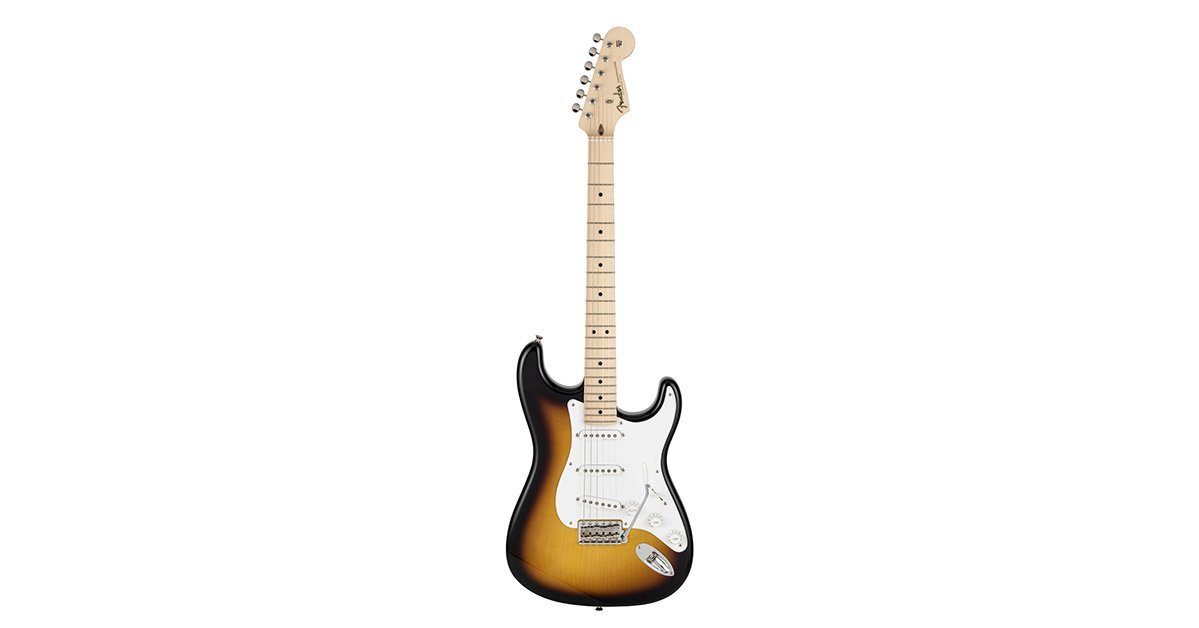
A German court has recognized copyright protection for the body design of the Fender Stratocaster, a ruling that has shaken the musical instrument industry. The Düsseldorf Regional Court found that the guitar's shape goes beyond mere function and carries its own creativity as a "work of applied art" — in other words, a form that copyright should protect.
The case concerned copy models that Yiwu Philharmonic Musical Instruments, a Chinese maker, sold to Germany through the online marketplace AliExpress. Fender has since used the decision to widen its intellectual property campaign, according to ITmedia News. The target is no longer only dead copies, but also models from established makers that resemble the Stratocaster. In Japan, Fender sent a warning letter to Yamaha, which appears to concern its PACIFICA series.
Fender is a longstanding US guitar brand, and the Stratocaster has been its signature electric guitar since its 1954 launch. Jimi Hendrix, Eric Clapton and Jeff Beck all played it, and it became a rock icon. It also shaped how later electric guitars were built, and many companies have sold copy models that imitate the body design.
What the ruling covers
Whether the PACIFICA is covered raises a question the ruling does not settle cleanly: does protection extend to the whole double-cutaway shape, the crescent-shaped cutouts where the neck joins the body? The answer appears to be a matter of degree. A double-cutaway shape is not automatically off limits. The dispute ahead is how much of the Stratocaster's distinctive, creative form a rival model reproduces.
The German ruling has no direct effect in Japan. What it does create is a practical risk for products exported to the EU.
A brand push beyond guitars
Fender has been working to raise the value of its brand, and the legal action appears to be part of that. On January 13, 2026, it renamed Studio One, the music production software of its US subsidiary PreSonus, as Fender Studio Pro. The software's functions did not change much, and the renaming looks like another piece of brand strategy.
Studio One was known for its sound quality and held in high regard by professionals, so the change drew both praise and criticism. Some users said they would miss the Studio One name. Fender is famous as a guitar brand, but it appears to want a firmer presence in music software too.
Instrument makers have gone down this road before. Opcode Systems, a US company, made Studio Vision for the Macintosh, released in 1990, and the software existed from 1985 into the late 1990s. Gibson bought Opcode in 1998 and then ended development of Studio Vision. Users around the world condemned Gibson. Gibson later bought Cakewalk, a software line then held by Roland, and it met a similar fate before a white knight revived the brand.
The pattern repeated: an instrument maker ventures into the unfamiliar software business and ends up killing a strong product line. There is no reason to expect the Studio One renaming to end the same way, and no wish to see it. But the history of instrument makers buying music software is one path that should not be walked again.
Some of the Opcode engineers who lost their work under Gibson are said to have later joined Apple's Core Audio and MIDI development team for Mac OS X.