
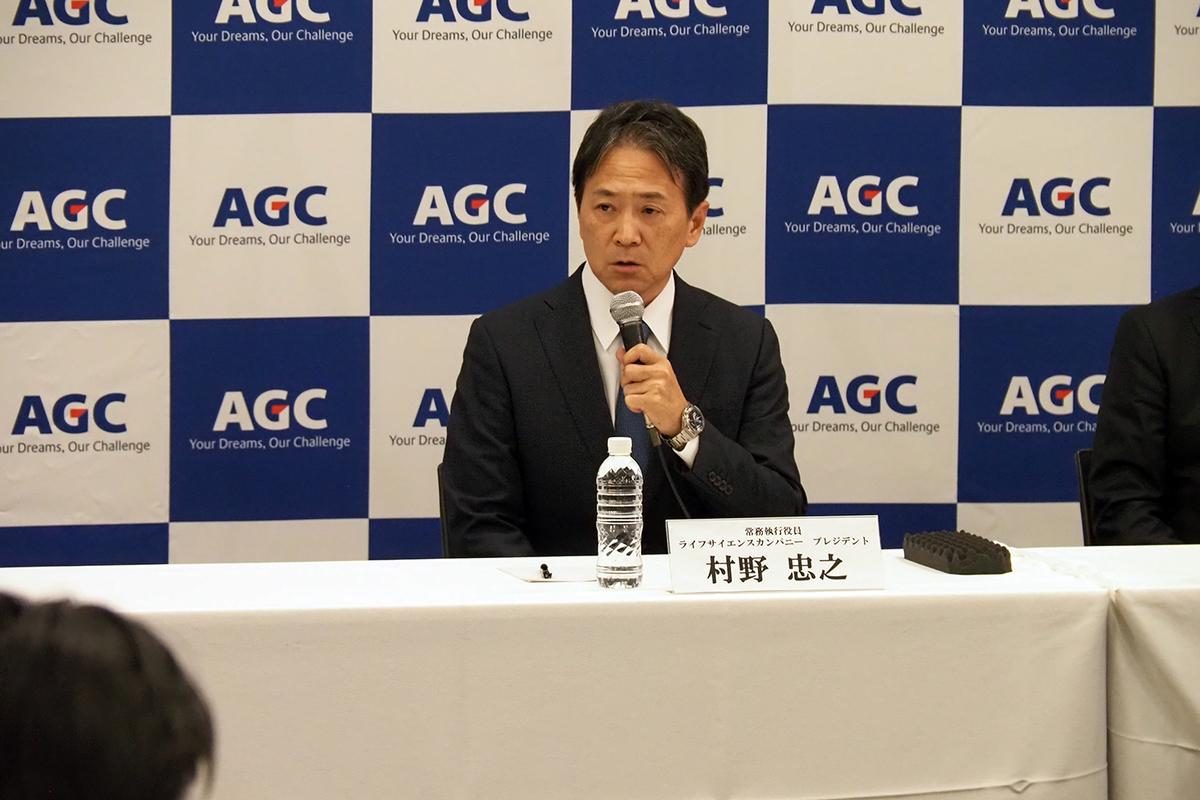
AGC said on Nov. 5 that Tadayuki Murano, a managing executive officer, will become president and CEO on Jan. 1, 2027. He will take the title of representative director after shareholder and board approvals at the general meeting and board meeting in March.
Yoshinori Hirai, who has led the company for six years since 2021, will move to chairman with representative rights on the same January date.
"We were able to grow the strategic businesses to a certain extent, but we could not stabilize the core businesses," Hirai said at a Nov. 5 press conference, looking back on his term.
Growth in new fields, weakness at home
AGC treats existing operations such as glass for building materials as its "core businesses" and newer growth fields as "strategic businesses." Those include electronics, which makes semiconductor materials, and life sciences, centered on contract development and manufacturing of biopharmaceuticals, or CDMO.
Over the past decade the strategic businesses grew to about a quarter of sales and more than half of operating profit, according to Hirai. The core businesses, which are more exposed to market swings, fell short of the goal of becoming a long-term stable earnings base.
Hirai's term began in January 2021, in the middle of the coronavirus pandemic. Energy prices then surged after Russia's invasion of Ukraine in 2022, and China's economy slowed during the recovery from the pandemic.
Hirai said that earnings structure, vulnerable to such shifts, contributed to the company's latest downward revision of its full-year forecast.
Murano: 'Can we really keep winning?'
Murano joined the former Asahi Glass in 1989. He worked across automotive glass, electronics and corporate planning, and has led the life sciences business since 2024.
At the press conference he named AGC's broad technology base, its global workforce and long-standing trust with customers as the company's strengths. He also said those assets are not being used fully, and described linking technology and people across business and regional lines as one of his main missions.
To strengthen the core businesses, he said the company will push productivity gains companywide and may work with other companies in some cases. He wants to close the distance between management and the market and the development floor, and to speed up decision-making.
Murano said discussions about past expansions were sometimes too loose, including whether AGC was the best owner of a given business. Rather than moving straight to layoffs or restructuring, he said, "we will thoroughly debate across all businesses whether we can really keep winning in them."
Profit forecast cut
For the year ended December 2025, AGC reported sales of 2.0588 trillion yen, down 0.4% from the previous year, and operating profit of 127.5 billion yen, up 1.3%. Net profit was 69.2 billion yen, reversing a loss of 94 billion yen the year before.
In its third-quarter results for the year ending December 2026, also announced on Nov. 5, AGC cut its full-year forecast. It left its sales forecast at 2.2 trillion yen but lowered operating profit to 120 billion yen from 150 billion yen, and net profit to 40 billion yen from 77 billion yen. Net profit would fall 42.2% from the previous year.
Higher manufacturing costs in automotive operations in North America and Europe, a slump in architectural glass and higher costs from energy prices weighed on operating profit. In life sciences, the biopharmaceutical CDMO business fell short of its sales volume target after production start-ups were delayed.